
Art or… and Education

Two texts have got me thinking recently. The first is a text by the art historian Griselda Pollock first published in 1985/6 and recently republished in a small book produced by Sternberg Press. The second is the chapter ‘Pedagogic Projects: ‘How do you bring a classroom to life as if it were a work of art’ in Claire Bishop’s book ‘Artificial Hells: Participatory Art and the Politics of Spectatorship’, which was published in 2012. Both essays have helped in my ongoing exploration of how we can understand and value artists’ ‘education’ work in museums.

Griselda Pollock’s text, the original version of which was a lecture given at the Royal College of Art, is a critique of art and art school pedagogy and practice from a feminist perspective. At the heart of her critique is a deconstruction of the ‘unquestioned notions of individualism’ in art history and society that celebrate ‘the idea of the self-motivating and self-creating artist who makes things that embody that peculiarly heightened and highly valued subjectivity…. a Romantic idea of the artist as the subjectivity whose works express both a personal subjectivity and a universal condition.’

Drawing on theorists including Karl Marx, Fredric Jameson, Raymond Williams, and Roland Barthes, Pollock argues instead that art is produced and received communally. Art’s ‘community’ includes all those practical activities that are necessary to make an artwork such as weaving canvas, manufacturing technology, or quarrying stones. It also includes the ‘conversational community’ who provide the wider conceptual context – the ‘commonality of terms, ambitions and criteria of assessment’ – that allow an art work to be understandable.

From this, Pollock argues that discerning the meaning of art is not about interrogating the individual artist’s biography and intentions, but instead requires the viewer, as a participant in this ‘social practice’, to create meaning from an awareness of their own positionality and the social and cultural conditions of the art work’s creation. In other words, we need to understand art itself as a collective enterprise – made by many and only meaningful within social and historical contexts of creation and reception. It is this ontological framing of art as a shared activity rather than as a singular creative enterprise which resonates for me.

Claire Bishop’s text addresses similar themes to those explored by Griselda Pollock, while focusing specifically on artistic practice that ‘claims to be pedagogic’. She begins the chapter by posing the interesting contradiction that ‘art is given to be seen by others, while education has no image’ before suggesting that participatory art ‘forecloses the traditional idea of spectatorship and suggests and new understanding of art without audiences, one in which everyone is a producer’. It would appear that Bishop too is advocating for a collective understand of art where the boundaries between artist and audience are reformed.

However, the chapter reveals that Bishop is uncomfortable with this position. She details various artists’ projects whose relational and/or educational practice involves direct participation by members of the public. Yet she admits that she often struggles with these projects’ visual and conceptual ‘rewards’. Notably she finds it difficult to reconcile the value for those participating directly, with the value given to those who are spectators. I share Bishop’s reservations about some of the artistic/education practices that were fashionable at the time she wrote the book and her exploration of artists who grapple with the participation/spectatorship dilemma in different ways is illuminating.

But what is actually most useful for me in Bishop’s text is her acknowledgment that we need to find different ways of judging and valuing art practices that involve both art and education. In her closing sentence to the chapter she makes the rallying cry that ‘we learn to think both fields together and devise adequate new languages and criteria for communicating these transversal practices.’ I could not agree more.

We need to move beyond judging artist led education practices, especially those commissioned by education/learning curators in museums, according to the individualistic criteria so effectively critiqued by Griselda Pollock. If we fail in this, we will continue to misunderstand and misrepresent a practice that is both art and education and also potentially something else that requires new language and ways of thinking.
Ways into the art

In the first chapter of her wonderful memoir of, in her words, ‘art and life and sudden death’, the UK art critic Laura Cumming makes the following statement;

‘.. pictures can shore you up, remind you who you are and what you stand for. The relationship we have with them is so singular and unique that nobody can gainsay our experience. What you see is what you see, yours alone and always true to you, no matter what anyone else contends.’

Having looked up what ‘gainsay’ means (it means to deny or contradict), I have been mulling over this observation, which resonates in many ways with how I think about the experience of looking at art. We bring our own perspectives, informed by our life experiences, different knowledge and emotional state to any encounter with an art object. Hopefully, we gain understanding and make meaning though connecting with art, almost by being in conversation with it. If the encounter goes well, the artwork ‘speaks’ to us and we in turn communicate back to it, bringing our ideas and feelings to interpret what we see and sense more broadly. Through this dialogic process we enter into a relationship with the art that is, as Laura Cumming acknowledges, ours alone.

But what if the encounter does not go well? What if the art object remains silent and we cannot make any connection at all? Rather than entering into a dialogue we are confronted by an unfamiliar, and intimidatingly inaccessible object. In that moment we can feel uncomfortable and, as I have experienced so often, make the decision to turn away and move on. The opportunity to develop a relationship with the art object is lost, and with that all the potential richness and inspiration that comes with a positive encounter.

It comes as no surprise then that many of the principles on which gallery education practice is based are intended to support visitors to make that personal connection with art. The aim is often to give people ‘tools for looking’ and strategies for making meaning creatively. One of these approaches is the ‘Ways In’ approach that was originally conceived as ‘Ways of Looking’ at Tate Liverpool in the 1990s and for a while was implemented across all of Tate’s learning programmes. The approach, which is documented in the publication ‘The Art Gallery Handbook‘ is based on four frameworks – ‘A Personal approach’, ‘Ways into the object’, ‘Ways into the subject’ and ‘Ways into the context.’ Each framework is underpinned by a series of questions to help the viewer engage with the artwork, without dictating what their interpretation should be.

The ‘Personal approach’, for example, includes the questions ‘what are my first reactions and why might it make me feel this way?’ ‘Ways into the object’ invites the viewer to question, amongst other formal qualities of the work, why the artist might have used particular materials and processes. ‘Ways into the subject’ focuses on what the work is about – what questions is the work asking? And ‘Ways into the context’ invites the viewer to explore when and where the work was made and who was the artist, as well as taking into account the space the work is being shown in. These frameworks are not intended to be rigid, but rather are springboards for personal investigation. In some cases, the answers to the questions cannot be provided by the artwork alone and rely on the viewer having access to information that might be provided by an interpretation label or leaflet or online. This information however, is also not intended to determine what the viewers’ understanding of the artwork should be, but rather to help them to make, as the Handbook states, an ‘informed response’.

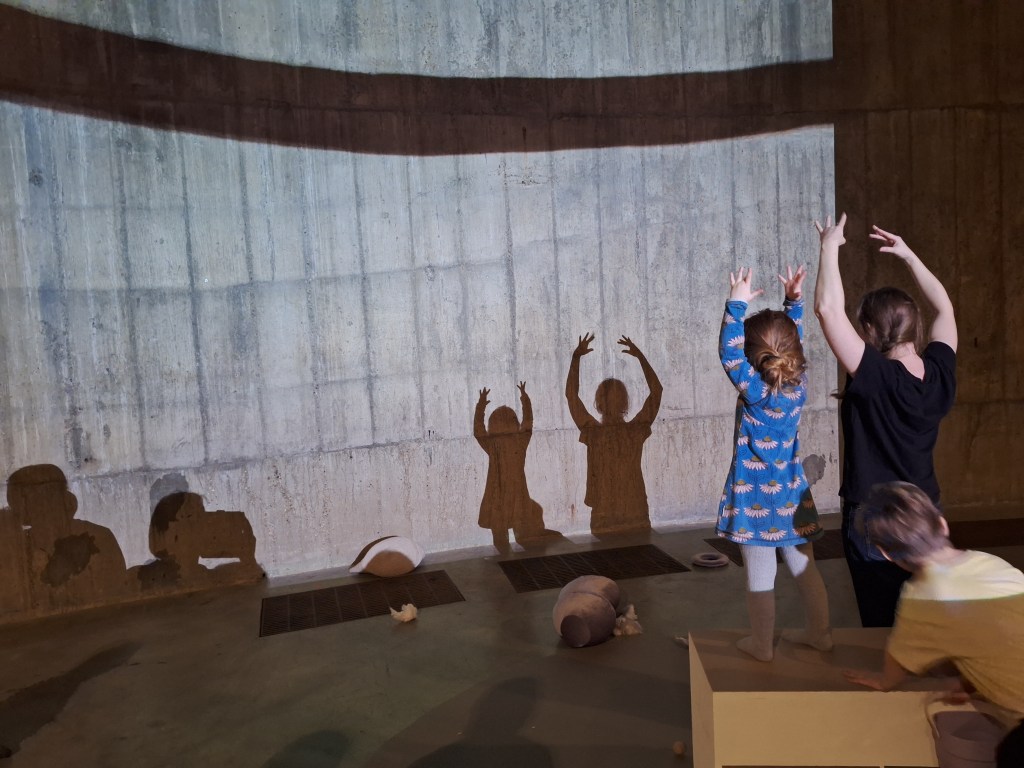
Visitors engaging with the ‘Joy of Feeling’ installation at Tate Modern, reminding me that not all engagement with art is visual and/or intellectual…

I have been thinking of the ‘Ways of Looking’ framework in relation to Laura Cumming’s statement. For, while I agree that ‘pictures can shore you up, remind you who you are and what you stand for,’ if we cannot find a means by which to connect with an art object, this fantastic affirmative process cannot happen. Galleries are complex places where entrenched hierarchies of knowledge and opaque rituals can be intimidating (for a helpful analysis of the impact of epistemological hierarchies I warmly recommend Deborah Riding’s paper which can be found here). And that is before you get to the art object itself. Having a few interpretive tools to draw on can help to build connections and get the dialogue with art started.