Art or… and Education

Two texts have got me thinking recently. The first is a text by the art historian Griselda Pollock first published in 1985/6 and recently republished in a small book produced by Sternberg Press. The second is the chapter ‘Pedagogic Projects: ‘How do you bring a classroom to life as if it were a work of art’ in Claire Bishop’s book ‘Artificial Hells: Participatory Art and the Politics of Spectatorship’, which was published in 2012. Both essays have helped in my ongoing exploration of how we can understand and value artists’ ‘education’ work in museums.

Griselda Pollock’s text, the original version of which was a lecture given at the Royal College of Art, is a critique of art and art school pedagogy and practice from a feminist perspective. At the heart of her critique is a deconstruction of the ‘unquestioned notions of individualism’ in art history and society that celebrate ‘the idea of the self-motivating and self-creating artist who makes things that embody that peculiarly heightened and highly valued subjectivity…. a Romantic idea of the artist as the subjectivity whose works express both a personal subjectivity and a universal condition.’

Drawing on theorists including Karl Marx, Fredric Jameson, Raymond Williams, and Roland Barthes, Pollock argues instead that art is produced and received communally. Art’s ‘community’ includes all those practical activities that are necessary to make an artwork such as weaving canvas, manufacturing technology, or quarrying stones. It also includes the ‘conversational community’ who provide the wider conceptual context – the ‘commonality of terms, ambitions and criteria of assessment’ – that allow an art work to be understandable.

From this, Pollock argues that discerning the meaning of art is not about interrogating the individual artist’s biography and intentions, but instead requires the viewer, as a participant in this ‘social practice’, to create meaning from an awareness of their own positionality and the social and cultural conditions of the art work’s creation. In other words, we need to understand art itself as a collective enterprise – made by many and only meaningful within social and historical contexts of creation and reception. It is this ontological framing of art as a shared activity rather than as a singular creative enterprise which resonates for me.

Claire Bishop’s text addresses similar themes to those explored by Griselda Pollock, while focusing specifically on artistic practice that ‘claims to be pedagogic’. She begins the chapter by posing the interesting contradiction that ‘art is given to be seen by others, while education has no image’ before suggesting that participatory art ‘forecloses the traditional idea of spectatorship and suggests and new understanding of art without audiences, one in which everyone is a producer’. It would appear that Bishop too is advocating for a collective understand of art where the boundaries between artist and audience are reformed.

However, the chapter reveals that Bishop is uncomfortable with this position. She details various artists’ projects whose relational and/or educational practice involves direct participation by members of the public. Yet she admits that she often struggles with these projects’ visual and conceptual ‘rewards’. Notably she finds it difficult to reconcile the value for those participating directly, with the value given to those who are spectators. I share Bishop’s reservations about some of the artistic/education practices that were fashionable at the time she wrote the book and her exploration of artists who grapple with the participation/spectatorship dilemma in different ways is illuminating.

But what is actually most useful for me in Bishop’s text is her acknowledgment that we need to find different ways of judging and valuing art practices that involve both art and education. In her closing sentence to the chapter she makes the rallying cry that ‘we learn to think both fields together and devise adequate new languages and criteria for communicating these transversal practices.’ I could not agree more.

We need to move beyond judging artist led education practices, especially those commissioned by education/learning curators in museums, according to the individualistic criteria so effectively critiqued by Griselda Pollock. If we fail in this, we will continue to misunderstand and misrepresent a practice that is both art and education and also potentially something else that requires new language and ways of thinking.

Learning through Doing

Museum professionals are quite rightly preoccupied with how best to support visitors to enjoy themselves and learn in the museum. In my experience, however, these same professionals spend less time examining how they (and therefore their institutions) might learn and grow. The pressures of busy programming schedules, at times combined with entrenched working patterns and inflexible hierarchies can inhibit staff from questioning their practice in positive and productive ways. Yet my own and others’ research has demonstrated that cultural organisations benefit enormously from prioritising research into, analysis of and reflection on their culture and activities. These ‘learning’ organisations are characteristically nimble, creative and reflexive spaces, able to test out ideas, face challenges and respond to the needs and wishes of their collaborators and visitors.

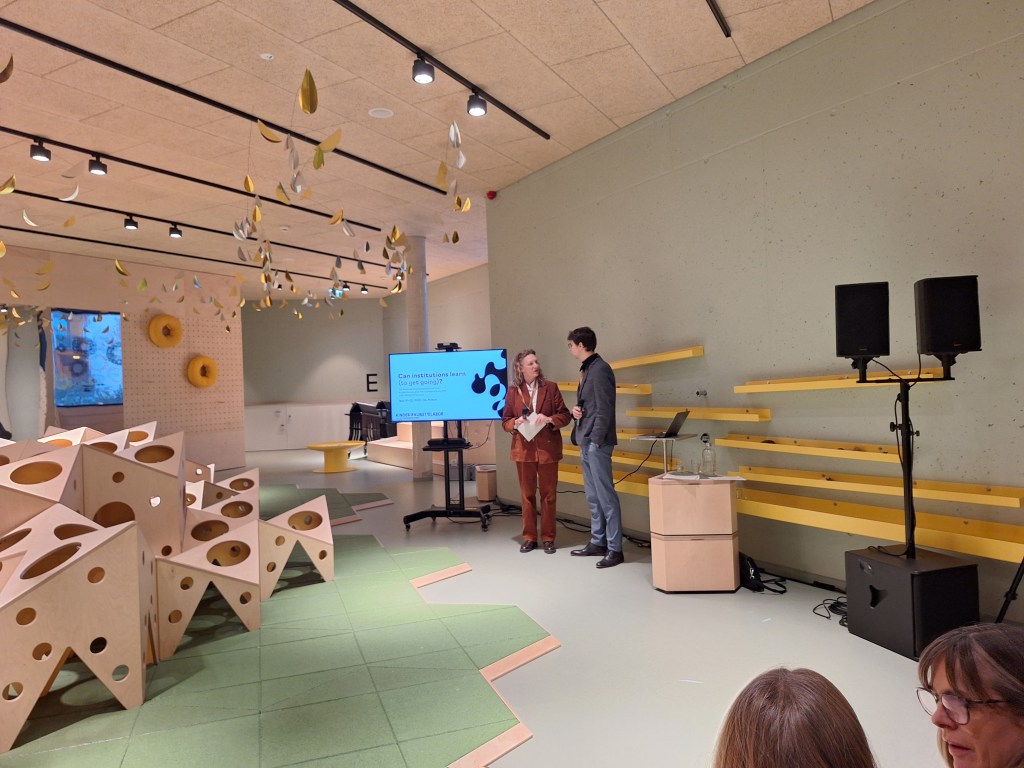
With these thoughts in mind, I was delighted to participate in the two-day symposium ‘Can institutions learn (to get going?)’ in Austria in November. The symposium was convened by Dr Mona Jas, the Artistic Director of KinderKunstLabor and Dr Aron Weigl, Executive Director of EDUCULT and was held at KinderKunstLabor, the newly opened contemporary art museum that thinks with and for children situated in St. Pölten. As the title suggests, the symposium examined the strategies and practices that different organisations and individuals employ to understand what they are doing and how they might do it better. We heard presentations from curators, policy makers, academics and researchers, had a tour of the museum itself and the current exhibition ‘dream.lab’ by Brazilian artist Rivane Neuenschwander and participated in artist-led workshops. We also ate together and had time for rich conversations between the presentations. It was a very rich and informative experience which gave me much food for thought. In particular, the following themes seemed to recur in a number of the talks and conversations.

What came across strongly is that people and hence institutions learn through doing.  It is through experiencing the reality of programmes and activities (and especially if these do not go according to plan) that we learn how to work with others in the museum. Alice Walton and Leanne Turvey, the Senior Curators for the Schools and Teachers Programme at Tate, for example, spoke compellingly about how ‘points of difficulty’ in their programming prompted new and better-informed ways of working with young people with special needs. Their practice, as with other speakers’ work, is highly theorised and deeply considered, but it is through witnessing the programmes in action that these practitioners understand what actually happens. Theory alone is never enough.

However, this experiential learning can only happen if we are prepared to listen, question our own opinions and move out of our comfort zones.  We learn by accepting change and allowing our ideas to be informed by the ideas of others. Collaborative experimentation, combined with ongoing shared reflection is essential if institutions and the people within them are to grow and learn. The presentation by Muhammet Ali Bas on his experience as a curator and educator of city projects for the Tangente St. Pölten Festival highlighted this point. He described the importance of listening to oneself and to collaborators both to develop genuinely co-created events, but also to ‘unlearn’ old and unhelpful patterns of working.

Mona Jas and Aron Weigl speaking on day one of the symposium

The language and methods that museum practitioners use is very significant in terms of including and excluding people.  Anahita Neghabat was researcher in residence at KinderKunstLabor from August 2023 to February 2024. Her talk showcased the research she undertook during that time, which evidenced that institutions must embrace plurality and non-linear exploration to avoid reinforcing exclusionary practices. This pluralism applies equally to artistic, research and mediation processes, so that diverse perspectives can be accommodated equally. Learning to use multiple languages (visual and linguistic) is helpful, not only in relation to communication, but also in shaping the institution more broadly.

Allowing children to engage directly with materials, art and artists is a powerful way of giving them agency to create and, as Anahita said, ‘dream themselves into different spaces.’ But power relations always exist in museums and institutions must pay close attention to who is present in the museum space and who has the power to speak and act. In a conversation that Anahita and I had after she spoke we talked about trust and why this is so important. Children must trust that the institution will welcome them and their ideas and the institution must have trust in children and allow them autonomy and agency. If this trust does not exist, the children and the museum will struggle to learn.

This is only a fraction of the ideas that were exchanged during the symposium. Reflecting on it now, I am conscious of the fact that the event itself manifested many of the ways that an institution can learn ‘to get going’, as the title provoked. We were invited to talk, listen, collaborate, share and question our ideas, reflect and change. We were welcomed into the space and trusted to contribute our views and to create our own objects during the workshops. I learnt a great deal.

A publication has also been produced to accompany the symposium, with texts in German and English.