Communities of Practice

In the last nine months I have been fortunate to attend three seminars/conferences/gatherings of gallery and museum education professionals. In May 2025 I was part of the ‘Participation as Practice’ event at the Munch Museum in Oslo, where we focused on what it means to curate participation with artists for audiences with the art museum. In early November 2025 I attended the engage (the UK National Association for Gallery Education) Gathering in Bradford, where the focus was on reflecting back on visual arts engagement and gallery education from the past 50 years, to imagine practice going forwards. The last week of November found me in Berlin at the 4th International Conference of the Leibniz Centre of Excellence for Museum Education exploring the theme of ‘Diversity and Discourse: Engaging Museum Visitors in the 21st Century’ with colleagues drawn predominantly from science and natural history museums.

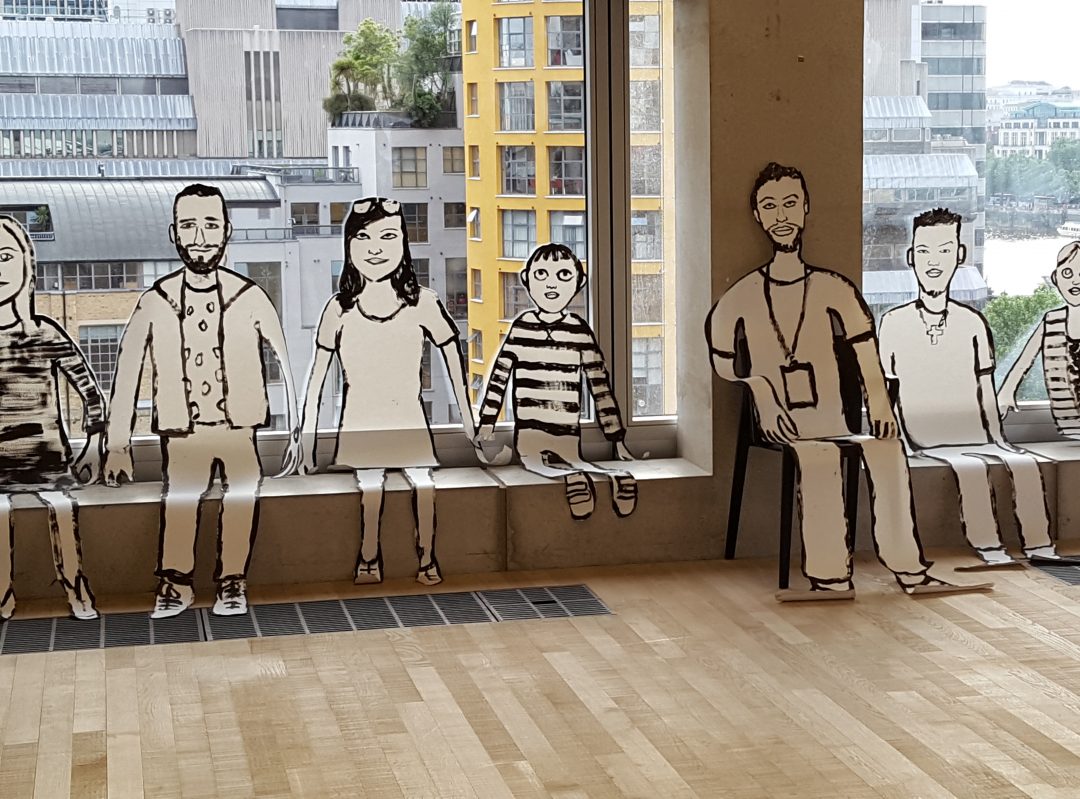
Molly Molloy from Tate Modern and Tove Sørvåg from Munch Museum presenting at the ‘Participation as Practice’ seminar

Each of these events were rich and rewarding, providing opportunities to hear from colleagues from the UK, Europe and further afield. Each offered insights into the variety of practice across museum and gallery education (historically, geographically, and in relation to different collections), and demonstrated the rigour of the research being conducted on and around these practices. Informal conversations during the events were, as ever, enlightening. I came away from each event with a clearer picture of the challenges the sector is facing, alongside the optimism and pragmatic choices colleagues are applying to make the sector fit for the complexities of the world today. The presentations and discussions reminded me why so much museum and gallery education work is highly theorised, but is also learnt through the doing of practice.

All three of these events demonstrated why it is vital for museum and gallery education professionals to gather together. Etienne Wenger and Jean Lave’s well-known theory of ‘Communities of Practice’ (CoP) is helpful here in rationalising why such regular group interaction is so valuable. A CoP can be described as a group of people who have a deep interest in something they do and, crucially, learn how to do it better through regular interaction with others. CoPs have three distinct characteristics; they share a common pool, or ‘domain’ of knowledge and understanding, which supports shared learning and participation; they are based in community, which allows for collaboration; finally their focus is on practice – on the doing – and how we can learn from this. These characteristics were very present at all three of the events I attended.

For example, despite having different focuses, themes came up in discussions at each event that reflected a shared domain of knowledge in terms of what constitutes best practice. The importance of time, for instance, and the need for trust in and from visitors. The value of experimentation and of authentic collaboration with audiences also surfaced, as did the unpicking of hierarchies of knowledge to allow for new and plural ways of knowing. Participants at each event brought their informed perspectives on these themes to the presentations and discussions. Dialogue within the community stimulated further debate and fresh insights for those present.

It was noticeable too, how many of the presentations at all three events were based around case studies of practice. Colleagues shared examples of projects they had been working on, in some cases to illuminate a theory in action, or to demonstrate how a problem or issue was being tackled through a specific intervention. We were shown not only the aims and outcomes of projects, but essentially we also got to see, hear and discuss processes and the evolution of practices, in some instances over many years.
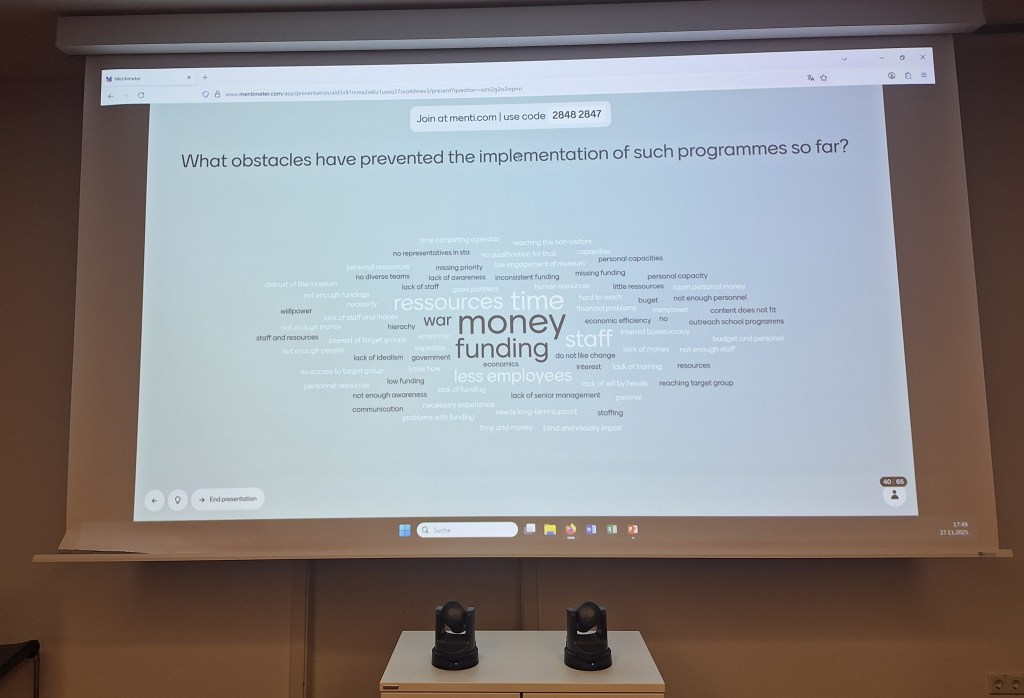
Results from a group exercise at the Leibniz conference in response to the question ‘what obstacles have prevented the implementation of programmes to increase audience diversity?’

It goes without saying that gallery and museum education is an incredibly diverse field. I met colleagues from small regional art galleries and huge national museums, from relatively well-funded research museums through to art galleries whose budgets have been brutally cut in recent years. Each colleague was dealing with their own histories, audiences, institutional priorities and wider policy directives. Yet the community of practice was clear to me, as was the enormous value to the members of this CoP of coming together to share and learn. It is, perhaps, because the field is so broad, that we need as many chances to share practice in person as possible.
Democratising Culture and Cultural Democracy

I have written before on how certain ideas or even quotations can encapsulate a whole set of practices.  In my mind, democratising culture and cultural democracy are two of these essential concepts that offer a compelling theoretical rationale for gallery education and audience-focused museum practices more broadly. 

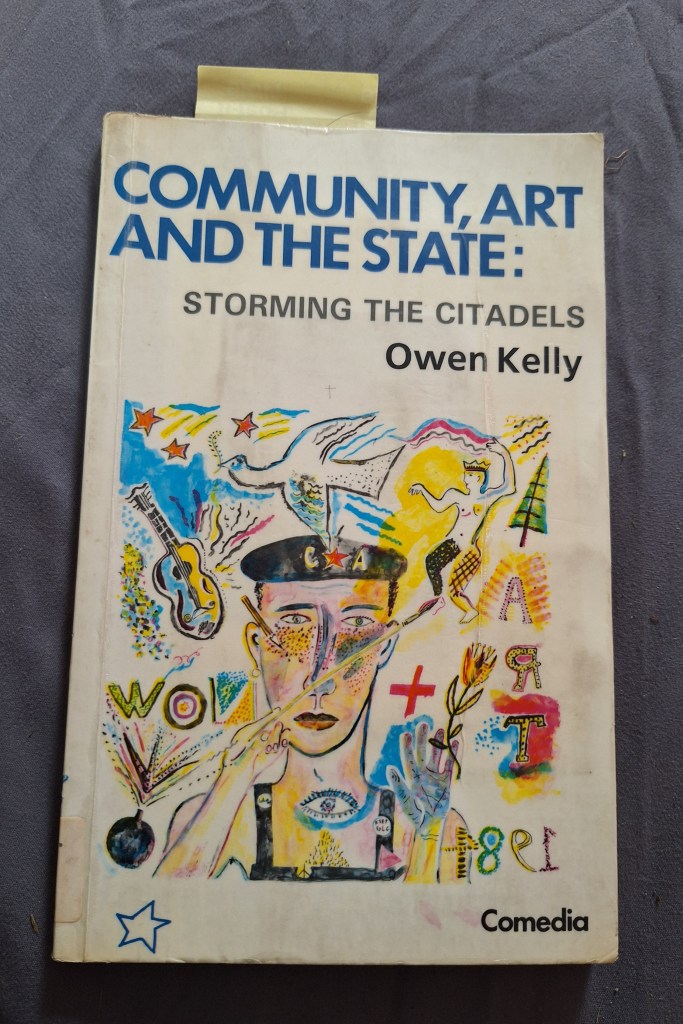
I first came across the concepts of democratising culture and cultural democracy in the late 1990s in Owen Kelly’s excellent polemical text on the development of community art in the UK that was first published in 1984.  In chapter 14 of the book Kelly takes issue with the argument that what can be understood as ‘high culture’ in the form of ballet, theatre, painting, sculpture, and opera needs to be democratised through education programmes and ‘intelligent popularisation’ so that those beyond the middle classes might be persuaded to watch and gain from them.  The spreading of an already determined cultural agenda is what can be understood as democratising culture.

Kelly does not dismiss democratising culture outright, but he questions why ‘there is a centrally controlled and co-ordinated set of cultural outputs at all,’ before going on to ask ‘who is it that selects the content of this set, and on whose authority [do] they do so.’  Kelly’s argument is that what is deemed to be high culture is never neutral, but rather serves the interests and reinforces the values of only a small group of society.  It follows therefore, that democratising this culture might not be as liberating and enriching as intended, but could instead be seen, in Kelly’s words, as ‘an oppressive imposition, a radical monopoly exerted by a certain way of seeing and organising experience.’ 

It is important to make clear at this point that according to Owen Kelly taking an already determined cultural agenda to ‘the masses’ is contentious, not because ‘the masses’ should not have access to the great works of Shakespeare, or the art of Matisse for example.  It is tricky because it positions the majority of people as passive consumers of forms of culture that have already been determined as good for them, rather than as potential creators of culture themselves. 

This is where the concept of ‘cultural democracy’ comes in.  Cultural democracy is premised on the understanding that culture is not something to be determined by a small group, but is instead created and circulated by everyone. It assumes that cultural production takes place within wider social contexts and feeds back into those contexts, helping to make sense of them.  It is the creation of culture itself and the meaning that comes from this that is empowering and beneficial, not the consumption of pre-determined cultural forms.  Hence, enacting cultural democracy involves giving people access to the means of making culture and cultural understanding as much as possible for themselves.

So how are these ideas relevant to gallery education and museum practice more widely?  In my experience democratising culture and cultural democracy operate simultaneously within art museums on a macro through to a micro level. In very basic terms, initiatives including free entry, scholarly art historical lectures and talks that start with ‘in this painting we can see the artist was doing x’ represent the spectrum of democratising culture in action.   At the same time, programmes that invite the public to take over spaces and create their own art within the museum, or events that bring in different cultural forms, such as house music or graffiti, or even workshops that begin with ‘what do you think the artist is trying to say here?’ align more closely with the idea of cultural democracy. 

In my view, we need museums to be providing activities that both democratise culture and support cultural democracy.  Crucially though, we need to be aware of the difference between the two and who might benefit more from each.  That is one reason why these two concepts are so valuable.

The importance of welcome and care

These days I am more likely to visit a museum or gallery for my own personal pleasure and curiosity, rather than in a professional capacity. I go to see an exhibition that interests me, to meet friends and to see works in collections that I especially like. Perhaps for this reason I have become acutely aware of the overall visitor experience I have when I visit. I am more conscious of the costs of entry, or of buying a drink in the café, for instance. I notice how easy or not it is for me to get around and what information is made available to help me with this.

In particular I have started to register the extent to which I am made to feel welcome, both when I arrive at a museum and during my visit. In my mind, the welcome we receive is a fundamental and revealing manifestation of the values of any institution. As with any act of hospitality, a warm welcome is grounded in generosity, consideration and trust in those that are being invited into the space. It takes care to make people feel welcome. And, as Maria Puig de la Bellacasa writes in her book ‘Matters of Care‘, care is ‘a concrete work of maintenance, with ethical and affective implications’. In other words, care requires some affective involvement – I care for, I worry – but must be accompanied by the necessary labour, ‘the sometimes tedious maintenance of a relation’ through ‘putting in the work’ as de la Bellacasa notes.

A welcoming institution genuinely wants all those who visit to occupy their spaces, to relax and enjoy themselves and feel at home there. They pay attention to what will support their visitors to be inspired, challenged and comforted, should they need or wish to be. These institutions put in the work to try and make that happen.

There are multiple ways that we are made to feel welcome or not in the museum. One of which that has caught my attention is through the messages the museum chooses to communicate when you arrive. Below are two entirely unscientific observations based on my experiences over the last twelve months.

When I visited the MIT Museum in Cambridge, Massachusetts last Autumn. I was immediately struck by the message that greeted me by the entrance. It reads as follows:

Here is an explicit invitation for me and everyone else to come in and to join in. It locates the museum as a meeting place where we are encouraged to share our ideas and views. It communicates the museum’s appreciation that we have made the effort to visit. I, in turn, entered the museum feeling that, even though my knowledge of science and technology is minimal, I was welcome to be there.

A contrasting but equally significant message greeted me when I visited the Fitzwilliam Museum in Cambridge, UK in December 2023. It said:

Although not an explicit message of welcome, to me this sign also demonstrates care on the part of the institution. As has been highlighted particularly in recent years, museums are not neutral and their historic lack of transparency regarding their histories and exclusionary institutional cultures has contributed to many feeling profoundly unwelcome. As far back as 2001 the British museologist Eilean Hooper-Greenhill was arguing that museums need to acknowledge visibly the conflicts and contradictions implicit in the presentation and interpretation of culture. To become what she calls an inclusive ‘post-museum’ institutions need to recognise their responsibilities in addressing all aspects of their histories. This sign indicated to me a willingness on the part of the Fitzwilliam to attempt to do this.

I am, however, well-aware that it is relatively easy to install a sign and to state a desire on the part of the museum to invite everyone in and to be more open about their origins. I am also conscious that as a museum professional it will probably not take too much to make me feel at home in these spaces. Taking the necessary care and putting in the work so that those who might feel less confident in the gallery is what really counts.