Communities of Practice

In the last nine months I have been fortunate to attend three seminars/conferences/gatherings of gallery and museum education professionals. In May 2025 I was part of the ‘Participation as Practice’ event at the Munch Museum in Oslo, where we focused on what it means to curate participation with artists for audiences with the art museum. In early November 2025 I attended the engage (the UK National Association for Gallery Education) Gathering in Bradford, where the focus was on reflecting back on visual arts engagement and gallery education from the past 50 years, to imagine practice going forwards. The last week of November found me in Berlin at the 4th International Conference of the Leibniz Centre of Excellence for Museum Education exploring the theme of ‘Diversity and Discourse: Engaging Museum Visitors in the 21st Century’ with colleagues drawn predominantly from science and natural history museums.

Molly Molloy from Tate Modern and Tove Sørvåg from Munch Museum presenting at the ‘Participation as Practice’ seminar

Each of these events were rich and rewarding, providing opportunities to hear from colleagues from the UK, Europe and further afield. Each offered insights into the variety of practice across museum and gallery education (historically, geographically, and in relation to different collections), and demonstrated the rigour of the research being conducted on and around these practices. Informal conversations during the events were, as ever, enlightening. I came away from each event with a clearer picture of the challenges the sector is facing, alongside the optimism and pragmatic choices colleagues are applying to make the sector fit for the complexities of the world today. The presentations and discussions reminded me why so much museum and gallery education work is highly theorised, but is also learnt through the doing of practice.

All three of these events demonstrated why it is vital for museum and gallery education professionals to gather together. Etienne Wenger and Jean Lave’s well-known theory of ‘Communities of Practice’ (CoP) is helpful here in rationalising why such regular group interaction is so valuable. A CoP can be described as a group of people who have a deep interest in something they do and, crucially, learn how to do it better through regular interaction with others. CoPs have three distinct characteristics; they share a common pool, or ‘domain’ of knowledge and understanding, which supports shared learning and participation; they are based in community, which allows for collaboration; finally their focus is on practice – on the doing – and how we can learn from this. These characteristics were very present at all three of the events I attended.

For example, despite having different focuses, themes came up in discussions at each event that reflected a shared domain of knowledge in terms of what constitutes best practice. The importance of time, for instance, and the need for trust in and from visitors. The value of experimentation and of authentic collaboration with audiences also surfaced, as did the unpicking of hierarchies of knowledge to allow for new and plural ways of knowing. Participants at each event brought their informed perspectives on these themes to the presentations and discussions. Dialogue within the community stimulated further debate and fresh insights for those present.

It was noticeable too, how many of the presentations at all three events were based around case studies of practice. Colleagues shared examples of projects they had been working on, in some cases to illuminate a theory in action, or to demonstrate how a problem or issue was being tackled through a specific intervention. We were shown not only the aims and outcomes of projects, but essentially we also got to see, hear and discuss processes and the evolution of practices, in some instances over many years.
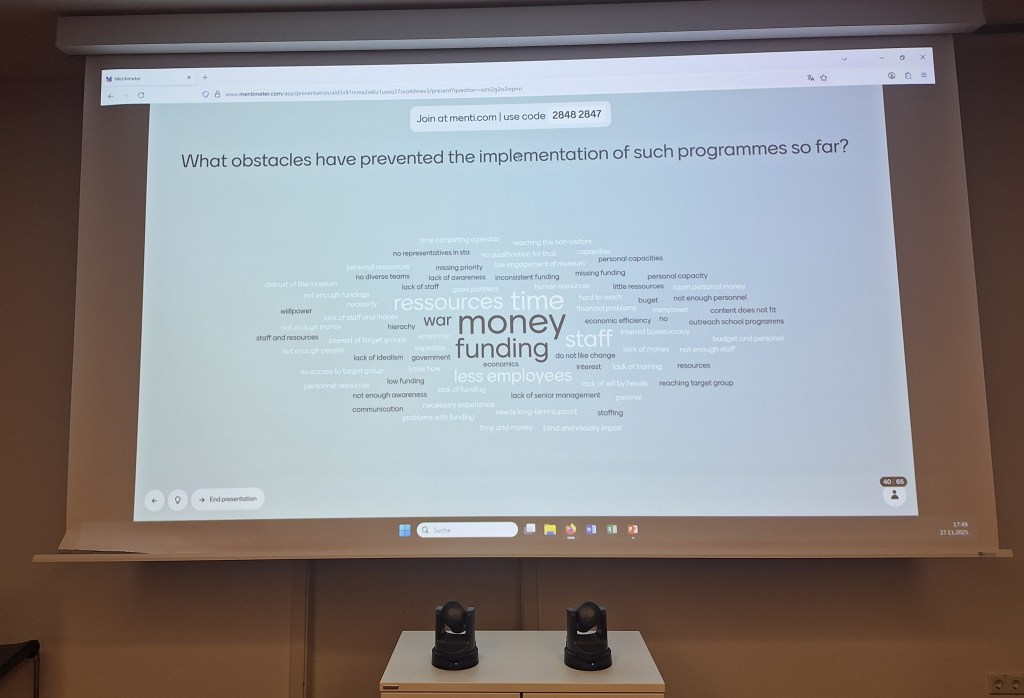
Results from a group exercise at the Leibniz conference in response to the question ‘what obstacles have prevented the implementation of programmes to increase audience diversity?’

It goes without saying that gallery and museum education is an incredibly diverse field. I met colleagues from small regional art galleries and huge national museums, from relatively well-funded research museums through to art galleries whose budgets have been brutally cut in recent years. Each colleague was dealing with their own histories, audiences, institutional priorities and wider policy directives. Yet the community of practice was clear to me, as was the enormous value to the members of this CoP of coming together to share and learn. It is, perhaps, because the field is so broad, that we need as many chances to share practice in person as possible.

Learning through Doing

Museum professionals are quite rightly preoccupied with how best to support visitors to enjoy themselves and learn in the museum. In my experience, however, these same professionals spend less time examining how they (and therefore their institutions) might learn and grow. The pressures of busy programming schedules, at times combined with entrenched working patterns and inflexible hierarchies can inhibit staff from questioning their practice in positive and productive ways. Yet my own and others’ research has demonstrated that cultural organisations benefit enormously from prioritising research into, analysis of and reflection on their culture and activities. These ‘learning’ organisations are characteristically nimble, creative and reflexive spaces, able to test out ideas, face challenges and respond to the needs and wishes of their collaborators and visitors.

With these thoughts in mind, I was delighted to participate in the two-day symposium ‘Can institutions learn (to get going?)’ in Austria in November. The symposium was convened by Dr Mona Jas, the Artistic Director of KinderKunstLabor and Dr Aron Weigl, Executive Director of EDUCULT and was held at KinderKunstLabor, the newly opened contemporary art museum that thinks with and for children situated in St. Pölten. As the title suggests, the symposium examined the strategies and practices that different organisations and individuals employ to understand what they are doing and how they might do it better. We heard presentations from curators, policy makers, academics and researchers, had a tour of the museum itself and the current exhibition ‘dream.lab’ by Brazilian artist Rivane Neuenschwander and participated in artist-led workshops. We also ate together and had time for rich conversations between the presentations. It was a very rich and informative experience which gave me much food for thought. In particular, the following themes seemed to recur in a number of the talks and conversations.

What came across strongly is that people and hence institutions learn through doing.  It is through experiencing the reality of programmes and activities (and especially if these do not go according to plan) that we learn how to work with others in the museum. Alice Walton and Leanne Turvey, the Senior Curators for the Schools and Teachers Programme at Tate, for example, spoke compellingly about how ‘points of difficulty’ in their programming prompted new and better-informed ways of working with young people with special needs. Their practice, as with other speakers’ work, is highly theorised and deeply considered, but it is through witnessing the programmes in action that these practitioners understand what actually happens. Theory alone is never enough.

However, this experiential learning can only happen if we are prepared to listen, question our own opinions and move out of our comfort zones.  We learn by accepting change and allowing our ideas to be informed by the ideas of others. Collaborative experimentation, combined with ongoing shared reflection is essential if institutions and the people within them are to grow and learn. The presentation by Muhammet Ali Bas on his experience as a curator and educator of city projects for the Tangente St. Pölten Festival highlighted this point. He described the importance of listening to oneself and to collaborators both to develop genuinely co-created events, but also to ‘unlearn’ old and unhelpful patterns of working.

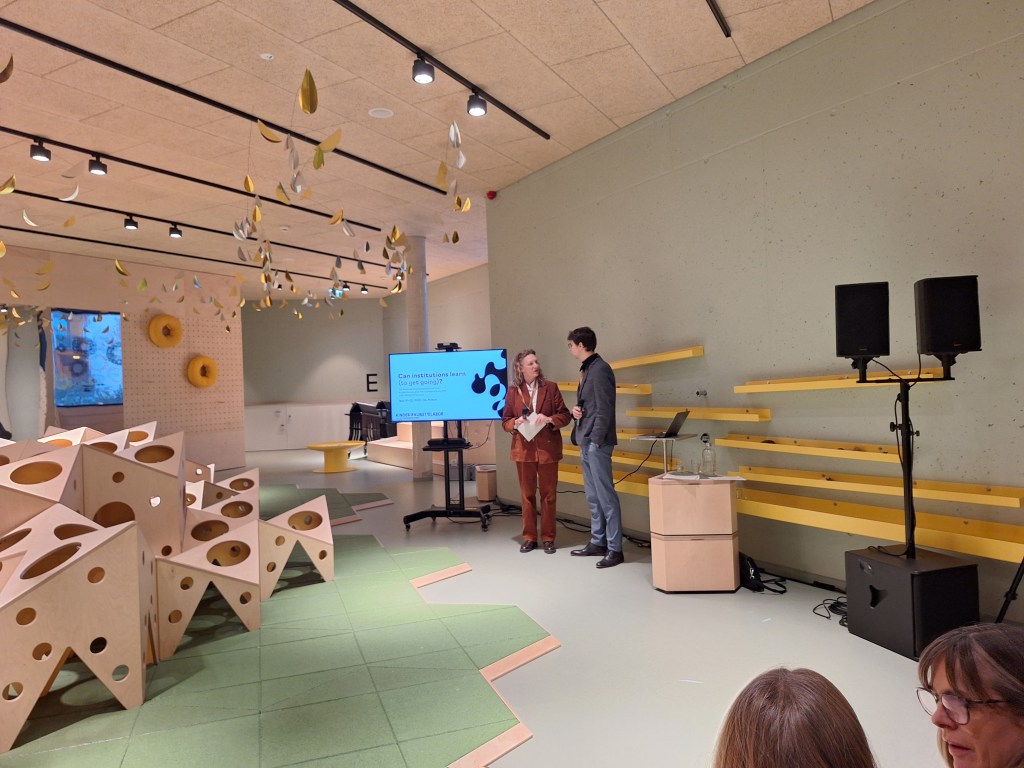
Mona Jas and Aron Weigl speaking on day one of the symposium

The language and methods that museum practitioners use is very significant in terms of including and excluding people.  Anahita Neghabat was researcher in residence at KinderKunstLabor from August 2023 to February 2024. Her talk showcased the research she undertook during that time, which evidenced that institutions must embrace plurality and non-linear exploration to avoid reinforcing exclusionary practices. This pluralism applies equally to artistic, research and mediation processes, so that diverse perspectives can be accommodated equally. Learning to use multiple languages (visual and linguistic) is helpful, not only in relation to communication, but also in shaping the institution more broadly.

Allowing children to engage directly with materials, art and artists is a powerful way of giving them agency to create and, as Anahita said, ‘dream themselves into different spaces.’ But power relations always exist in museums and institutions must pay close attention to who is present in the museum space and who has the power to speak and act. In a conversation that Anahita and I had after she spoke we talked about trust and why this is so important. Children must trust that the institution will welcome them and their ideas and the institution must have trust in children and allow them autonomy and agency. If this trust does not exist, the children and the museum will struggle to learn.

This is only a fraction of the ideas that were exchanged during the symposium. Reflecting on it now, I am conscious of the fact that the event itself manifested many of the ways that an institution can learn ‘to get going’, as the title provoked. We were invited to talk, listen, collaborate, share and question our ideas, reflect and change. We were welcomed into the space and trusted to contribute our views and to create our own objects during the workshops. I learnt a great deal.

A publication has also been produced to accompany the symposium, with texts in German and English.

Places to play in the art museum

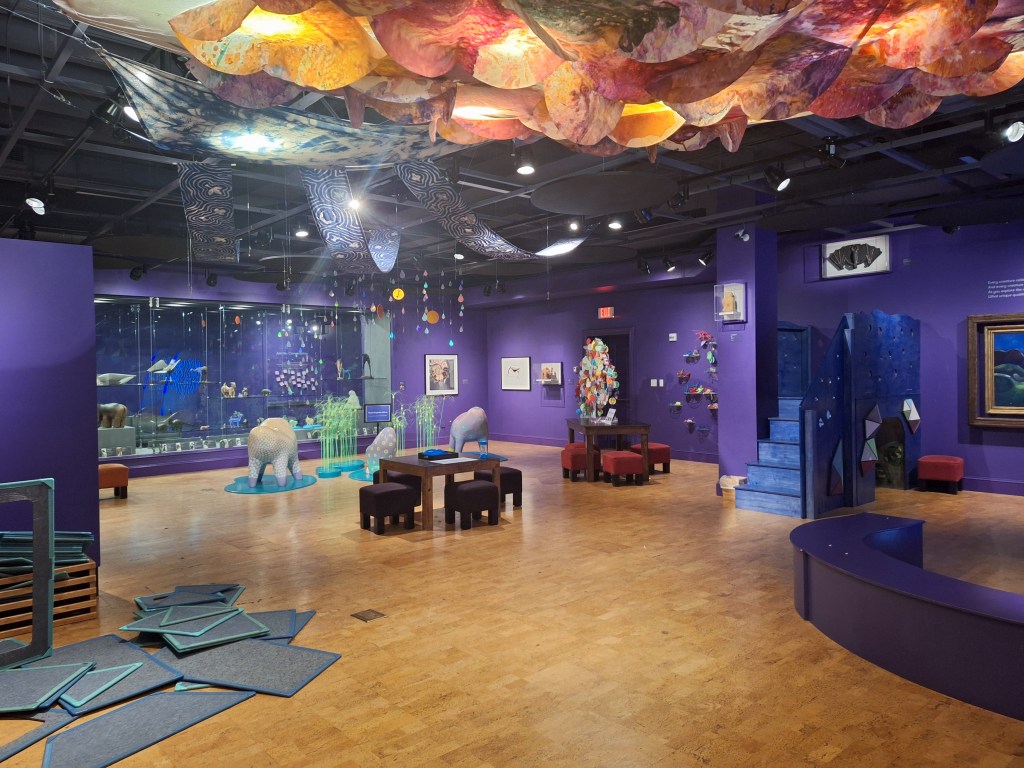
In September I was fortunate to be invited to Columbus, Ohio by Dr Dana Kletchka, Associate Professor of Art Museum Education at Ohio State University. During my short visit I met with Dana, her wonderful students and colleagues from the Wexner Center for the Arts. I was also taken on a tour of the Columbus Museum of Art (CMOA) by Hannah Mason-Macklin, the Director of Interpretation and Engagement at the Museum. There is much I could talk about from this inspiring visit, but in this post I want to focus on the suite of spaces at CMOA designated as the JPMorgan Chase Center for Creativity, in the middle of which is ‘The Wonder Room‘.

On the CMOA website The Wonder Room is described as ‘as a place for intergenerational exploration, play, connection, and discovery. Art is displayed in unexpected ways, and custom, hands-on activities are featured prominently near great works of art to inspire creativity in this family-friendly space.’ In reality the space is brightly coloured, with objects to handle, climb on and creatively respond to. The invitation made explicit in the space is for visitors to experiment and connect with art and artists through play, and as the website says ‘to exercise their courageous imagination’.

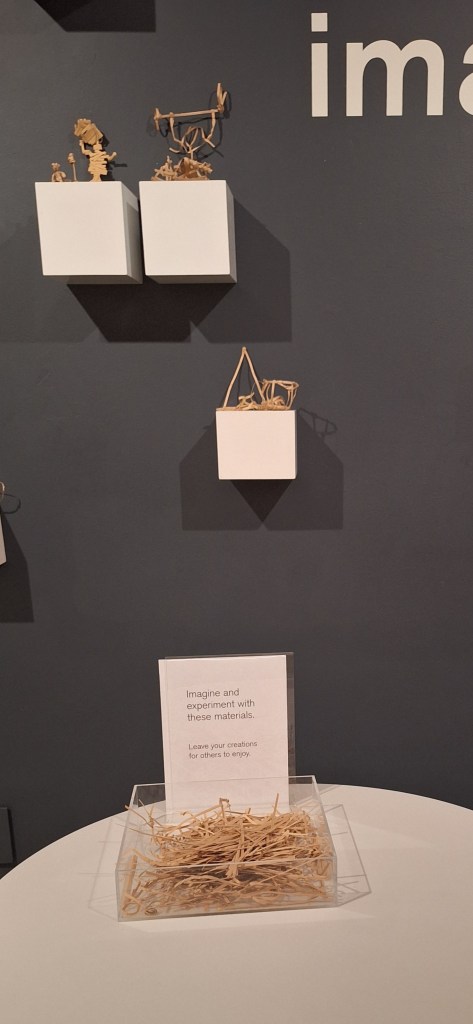
In the spaces circulating around The Wonder Room are further interventions that connect with the art in the museum through hands-on making activities. And although I was visiting the museum on a day when it was closed, I could easily imagine how engaging these spaces would be for visitors of all ages. The questions posed on the walls were open-ended and stimulating and the materials given for visitors to create with were simple, yet adaptable enough to allow for thoughtful creative responses.

Visiting CMOA reminded me how vital it is for art museums to provide opportunities for play and not only for children. Play, as writer and museum educator Claire Bown talks about in her ‘Thinking Museum‘ podcast is when we immerse ourselves in something for enjoyment’s sake. It is when we allow our imagination to range freely and when exploration and enquiry can bring joy and pleasure. Play empowers us and improves our social and emotional skills, whatever our age and playing with others brings us closer, allowing for human connection.

Increasingly art museums are providing spaces where play is actively encouraged. These spaces are generally curated by members of a Learning or Education department and frequently involve collaborations with artists. The brilliant ‘Come Think with Us’ initiative at the Munch Museum in Oslo is an example of Learning colleagues and artists working to create an immersive environment for intergenerational engagement and play. The most recent iteration of this being ‘Sofie’s Room‘, a collaboration with artists Roza Moshtaghi and Ronak Moshtaghi. Likewise the Uniqlo Tate Play interventions in the Turbine Hall at Tate Modern are collaborations that actively invite the playful participation of visitors of all ages. In the summer of 2024, for example, the artist Oscar Murillo worked with Learning and exhibition curators to create ‘The Flooded Garden‘, an installation where visitors were invited to work together to create a huge canvas inspired by the work of Claude Monet.

Creating these playful spaces in the museum achieves many positive outcomes for visitors and institutions. Primarily they act as a draw for families, but in my experience adult visitors can also relish opportunities to make things and have fun in the museum. These spaces also allow for a different mode of collaboration with artists, which requires expertise and sensitivity on the part of curators. It takes considerable skill to create genuinely engaging interventions that encourage productive structured play. Too many directions and playfulness is no longer possible; too little structure and visitors may not know how to connect, or not have the confidence to experiment. I know from talking with colleagues working on these programmes how much work goes into creating these generous and generative spaces. It is a serious business designing for play.

The importance of welcome and care

These days I am more likely to visit a museum or gallery for my own personal pleasure and curiosity, rather than in a professional capacity. I go to see an exhibition that interests me, to meet friends and to see works in collections that I especially like. Perhaps for this reason I have become acutely aware of the overall visitor experience I have when I visit. I am more conscious of the costs of entry, or of buying a drink in the café, for instance. I notice how easy or not it is for me to get around and what information is made available to help me with this.

In particular I have started to register the extent to which I am made to feel welcome, both when I arrive at a museum and during my visit. In my mind, the welcome we receive is a fundamental and revealing manifestation of the values of any institution. As with any act of hospitality, a warm welcome is grounded in generosity, consideration and trust in those that are being invited into the space. It takes care to make people feel welcome. And, as Maria Puig de la Bellacasa writes in her book ‘Matters of Care‘, care is ‘a concrete work of maintenance, with ethical and affective implications’. In other words, care requires some affective involvement – I care for, I worry – but must be accompanied by the necessary labour, ‘the sometimes tedious maintenance of a relation’ through ‘putting in the work’ as de la Bellacasa notes.

A welcoming institution genuinely wants all those who visit to occupy their spaces, to relax and enjoy themselves and feel at home there. They pay attention to what will support their visitors to be inspired, challenged and comforted, should they need or wish to be. These institutions put in the work to try and make that happen.

There are multiple ways that we are made to feel welcome or not in the museum. One of which that has caught my attention is through the messages the museum chooses to communicate when you arrive. Below are two entirely unscientific observations based on my experiences over the last twelve months.

When I visited the MIT Museum in Cambridge, Massachusetts last Autumn. I was immediately struck by the message that greeted me by the entrance. It reads as follows:

Here is an explicit invitation for me and everyone else to come in and to join in. It locates the museum as a meeting place where we are encouraged to share our ideas and views. It communicates the museum’s appreciation that we have made the effort to visit. I, in turn, entered the museum feeling that, even though my knowledge of science and technology is minimal, I was welcome to be there.

A contrasting but equally significant message greeted me when I visited the Fitzwilliam Museum in Cambridge, UK in December 2023. It said:

Although not an explicit message of welcome, to me this sign also demonstrates care on the part of the institution. As has been highlighted particularly in recent years, museums are not neutral and their historic lack of transparency regarding their histories and exclusionary institutional cultures has contributed to many feeling profoundly unwelcome. As far back as 2001 the British museologist Eilean Hooper-Greenhill was arguing that museums need to acknowledge visibly the conflicts and contradictions implicit in the presentation and interpretation of culture. To become what she calls an inclusive ‘post-museum’ institutions need to recognise their responsibilities in addressing all aspects of their histories. This sign indicated to me a willingness on the part of the Fitzwilliam to attempt to do this.

I am, however, well-aware that it is relatively easy to install a sign and to state a desire on the part of the museum to invite everyone in and to be more open about their origins. I am also conscious that as a museum professional it will probably not take too much to make me feel at home in these spaces. Taking the necessary care and putting in the work so that those who might feel less confident in the gallery is what really counts.