Knowledge and autonomy, trust and responsibility – is this how museum professionals operate?

One of the ambitions for my research is to devise a framework for practitioner research in the art museum. To do this I have been looking into constructions of the ‘practitioner’ and the ‘professional’ and am trying to understand what characteristics are associated with these, particularly as they are often used interchangeably.

In many respects, the concept of the ‘practitioner’ is easy for me to grasp.  If we understand practice as Jean McNiff and Jack Whitehead do – as ‘what we do’ – then practitioners are doers. They are those that operate in the complex and messy world of practice, developing ideas and knowledge from their experiences, as well as from theory, and using their expertise to resolve problems in action. As an art museum educator and researcher with a background in fine art, I see myself as a practitioner. In other words, as someone who has a certain amount of theoretical knowledge (some art history, some cultural, curatorial and pedagogic theory, some museology, some ideas around art making, for instance), coupled with the practical knowledge I have built up through working with materials, running programmes, collaborating with colleagues and the public, writing, speaking and so on. I draw on my theoretical and practical knowledge all the time and both are vital for me to do my work effectively.
 

20170509_131147 (2)
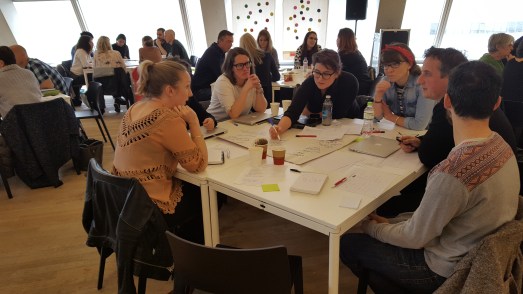
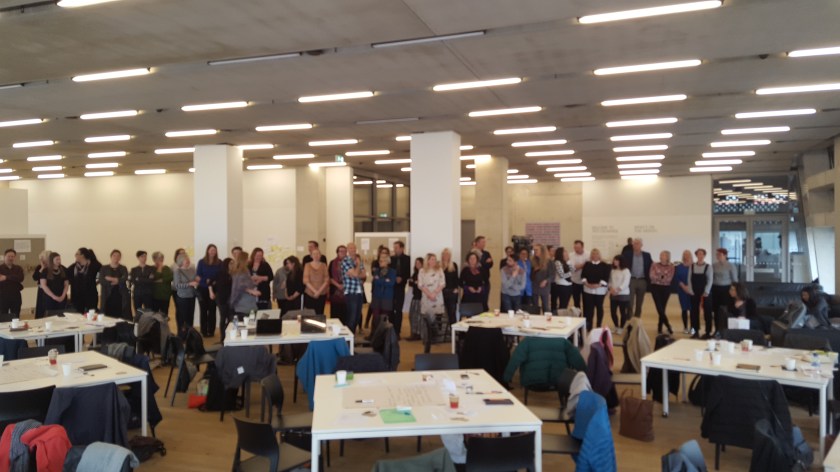
A gathering of art and education professionals at Tate Modern


But do I and others who work in museums qualify as professionals?  My default conception of the professional (apart, obviously, from the questionable 1970’s television crime-action drama) is of a doctor or lawyer, or possibly a teacher.  That is, someone with a clearly delineated occupation within a historically defined field.  I was not sure if the relatively new and more nebulous occupations of curator or museum educator, for example, qualify. However, indicators suggest that they do.  Nowadays organisations exist to represent the curator, with designated codes of conduct, which is one of the key features of a profession.  Whilst a strong case for considering the educator as a professional has been put forward by Helen Charman in her 2005 text.  Helen argues that the learning curator embodies the defining traits of the professional and enacts these in the museum context.  It is worth looking at these characteristics in detail as they illuminate how and why the professional acts within society.

The first of the characteristics is specialist knowledge, acquired through education and training, which enables the professional to address specific situations and problems and act in the public good. This specialist knowledge gives the professional a degree of freedom and autonomy to make their own judgements and act accordingly.  But with this autonomous status comes responsibility. Professionals can operate freely because of the trust that society invests in them to make good decisions and behave ethically and competently based on their expertise. It is these twinned characteristics – knowledge with autonomy, trust with responsibility – which inform how professionals work.  Which suggests that these traits must underpin the actions of those professionals, amongst others, who curate and facilitate programmes in museums.

These four characteristics resonate with my experience of working as an educator and researcher in the art museum and align with the reading I’ve done and conversations I have had with curators on their practice. It is the case that museum professionals have considerable expertise and work is a relatively autonomous way and are trusted to act ethically and conscientiously.  Educators in the UK, for instance, are not required to teach the national curriculum and curators are still largely in charge of designing their programmes.  Both take their responsibilities to artists, to a collection and to the public very seriously.

But museum professionals work in a complicated and challenging environment nowadays and the fragility of the relationship between knowledge, trust, responsibility and autonomy was brought home to me when I read a recent blog post by Courtney Johnson, the Director of the Dowse Museum in New Zealand.  In this post Courtney identifies four recent controversial situations in contemporary art galleries, where artists, activists and indigenous groups were moved to protest against decisions and actions the museums had taken.

I urge you to read the blog, so I won’t spell out the details here, but one observation that Courtney makes about trust and responsibility, has stuck with me. Having detailed the conflicting positions taken within the four case studies, Courtney questions the view often given that museums must retain their autonomy since they are ‘safe spaces for unsafe ideas’.  She argues that this self-serving argument shields the institution, allowing it to act in its own interests and not those of anyone who might be damaged by the showing of an ‘unsafe’ work.  It presumes a false insularity.  Instead, as Courtney says – ‘museums are still capable of doing violence – unknowingly, or thoughtlessly, or because we value the presentation of art and art history over the individuals, communities and cultures who may have been harmed in its making, and may continue to be harmed in its public display.’

Courtney’s observation that galleries may act ‘unknowingly or thoughtlessly’ and that their actions can be unethical, suggests a profound failing in terms of professional behaviour. And perhaps more critically, it implies that museums cannot be trusted to act in the public good.  Her words reveal one of the many dilemmas facing the twenty-first century art museum, that of how to open up a dialogue between the art on show and the world beyond the institution, rather than operating as a transmitter.  To accomplish this, I believe, the museum and the professionals within it need to maintain their specialist knowledge, but acknowledge the expertise of others and work less autonomously if they are to maintain the trust of their audiences.  This suggests that collaboration, the sharing of knowledge and an awareness of our own fallibility need to be added to the characteristics of the responsible museum professional.

I will be exploring these and other issues relevant to research in the art museum at two afternoon seminars at Tate Britain on April 26th and May 24th.  Places are very limited, but if you are interested in attending please email me on emily.pringle.ep@gmail.com.
Practice Research – Clarifying Terminology

One of my own confusions that I have been grappling with through this research period is what is meant by practice-based and practice-led research. My experience has been that these terms, which describe the generative and reciprocal relationship between research and practice, are different in subtle but significant ways. Yet they also seem to be used interchangeably at times. Being a bit of an obsessive when it comes to understanding terminology, I have been looking into how these terms are understood by others.
Within the field of creativity, Linda Candy’s differentiation is helpful. She describes practice-based research as ‘an original investigation undertaken in order to gain new knowledge partly by means of practice and the outcomes of that practice’, whereas practice-led research ‘is concerned with the nature of practice and leads to new knowledge that has operational significance for that practice’. In other words, practice-based research emphasises the practice itself as a mode of research, with the outcomes from practice, an exhibition, or performance for example, being legitimate research outcomes. Research that is practice-led, on the other hand, studies the practice itself and produces knowledge that informs the future development of that practice. In this way practice-led research resembles action research, in that it is a way of practitioners learning about and enhancing how something is done, through a focused study on it.
These two characteristics – that practice can be constructed as a form of research and that its purpose can be to bring about change – both appear relevant in the context of the art museum. Museum professionals in my experience are keen to locate their research as an integral part of their professional activity, seeing this a means by which to raise the profile of their programmes and activities and enhance and enrich their work. So, should we use both terms, or bring the two together, as in practice based/led research? To add further complexity, within Tate Learning we have been referring to our ongoing initiative with staff as ‘practice as research,’ in part to reinforce the equality of the relationship between the two activities. But does this term convey the various motivations, methods and outcomes associated with practice based/led research adequately?


20180313_164127
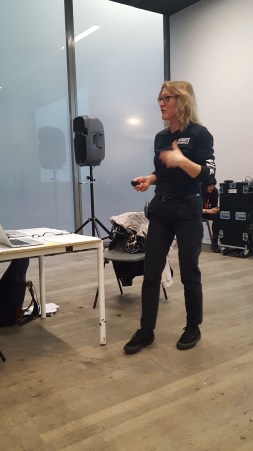
Dr Esther Sayers

These and other questions were at the centre of a presentation given by Dr Esther Sayers to staff at Tate Modern this week as part of a Practice as Research Forum organised by Helena Hunter, with the help of Rita Evans and Beckie Leach-Macdonald. Over the course of two hours, Esther took us nimbly through different understandings of practice itself and of what she described as ‘practice research,’ as this is the term that Goldsmiths College, where Esther works, has adopted. She highlighted the value of knowledge derived from doing as well as conceptual thinking, particularly in relation to researching gallery learning. She drew attention to the risk of ‘explaining’ rather than ‘encountering’ practice and of theorising away from practice rather than theory emerging from and returning to practice. She introduced us to methodologies that can be employed within practice research and had us undertake our own mini collaborative sensory ethnographic study within the Turbine Hall. The experience was illuminating and valuable for those of us taking part.


20180313_172528
Esther tasked my group with documenting the sounds we heard in the Turbine Hall over five minutes.  Other groups documented what they smelt or touched.

Esther also reinforced the importance of practice research being a space of uncertainty and discovery, where ideas can be explored and revised and where knowledge gained through an embodied engagement with stuff and people provides insights into what we do and how we operate in the world. This resonates with my own experience as a practitioner researcher who is learning all the time through the doing of my practice and my research. Yet my experience of the art museum also tallies with Esther’s cautionary note regarding the willingness of cultural organisations to live with unpredictability and ambiguity and acknowledge ‘not knowing’, all of which is necessary for practice research to thrive. Esther did not have a ready answer for this and neither do I, but she urged us to keep going and continue to implement practice research in all its various forms.

 
What I realised at the end of the session is that rather than spend forever fretting about the different terms, what is vital is to recognise the important contribution that practice, coupled with research, can make to our understanding of our work and how it sits in wider theoretical and doing contexts. The more I read and speak to people and involve myself in various institutions, the more I can see how practice as research, to stick with the Tate term, affords a means to deepen our knowledge and enhance the activities and experience of the museum.


Trying to define ‘research’ – ha, ha.

As my project is centrally concerned with the concept and practice of research it makes sense to try and establish a working definition of research for application in the art museum.  To help this process I ask everyone I interview and people I have more informal conversations with what they understand by the term ‘research’. This is a fascinating and extremely revealing process, although far from straightforward.

I have found that multiple and subtlety different constructions of research are held by those working in the art museum. The way people think and write about and do research is determined by, amongst other things, their values, disciplinary specialty, academic training and personal motivations. It is informed by how they construct the world, what knowledge they think is significant, the importance they place on notions of objectivity, even their sense of what it means to be human. And how people understand research determines the methods they adopt and the procedures they see as being rigorous.  It shapes the judgements of quality they bring to bear on the research questions, processes and outcomes and affects who, including themselves, they consider qualified to undertake research.

In a multi-dimensional and cross-disciplinary environment such as a museum it is not surprising that various formulations of research co-exist.  But in my mind this makes it all the more important to try and establish a shared understanding, or at least to surface the differences.  What emerges through my conversations is that the question of what constitutes research is rarely if ever discussed, let alone agreed.  As a result in my experience several, if not misconceptions, then at least contradictory perceptions of research exist in the minds of those working in museums and others beyond the institution.


20180215_115904
One of the Study Centres at the Harvard Art Museum where students, academics and members of the public can research and learn by working directly with works from the Museum’s collection.

For example, different views exist amongst those I have spoken to regarding the purpose of research in the art museum. The majority working within museums identify research as informing their practice and policies, but some argue that research, by definition, needs to contribute new knowledge to an academic field. Still others see research as a site for critical conversations and a mechanism to address pressing social and political issues. Similarly, there are individuals who see research as being a central responsibility of the museum, vital in discharging the core institutional functions of preserving the collection and supporting scholarship, learning and participation. Yet others locate academic research as a niche activity; rarefied, exclusive and in extreme cases, irrelevant to the twenty-first century arts organisation. The descriptions of research I’ve heard range from the broad and abstract to the detailed and discipline-specific, suggesting that for some it can be an inclusive and democratic process, whilst for others it is necessarily selective and specialist.

This confusion perhaps accounts for why several of the museum professionals I interviewed struggle to see themselves as researchers, despite in several cases being actively engaged in rigorous processes of enquiry. Research for many is perceived as an activity undertaken by a select few, not something they feel qualified or enabled (because of the demands of their role) to do. For some the barriers are time and resources, but for others it is the concept of ‘research’ and how it is structured that is opaque and intimidating.

20170509_121046

I am keen to find ways to bridge the gap between people’s perceptions of research as an exclusive and excluding activity and their own enquiry-based and reflective practices.  For that reason I have identified three common characteristics of research that surface in almost all the responses I’ve been given:

  1. The importance of questions – Questioning is central to all research practices in the museum. Research is premised on the asking of questions and the need to address or answer them. Often, but not always, these questions are located in practice; they emerge from practice and the knowledge that comes from the process of enquiry feeds back into practice.
  2. The process of enquiry – Questioning is accompanied by a structured process of enquiry. This may involve an intentional shift into a formal mode of investigation as well as a conscious progression from synthesizing existing ideas to the active generation of new knowledge. At the same time research that is practice-based is often seen to be a cyclical form of enquiry – a procedure that involves questioning, interrogating and thinking deeply on how and why actions are significant. It involves learning in and about practice and acting on that learning.
  3. The generation of new knowledge – Research involves generating new knowledge that goes out into the world. This new knowledge is made public through practice, through exhibitions and programmes and/or can take the form of more conventionally recognised academic research outputs including text based peer reviewed outputs.

I see these three characteristics as a starting point from which to build a shared understanding of research for the art museum.   They are far from conclusive and more work needs to be done around, for example, the issues of research quality and purpose, but I am hoping that they provide a basis for framing the variety of research activities that take place in art museums in a non-hierarchical and inclusive way.

As ever I would be very interested to hear people’s thoughts, so please leave a comment or get in touch with me at emily.pringle.ep@gmail.com


Curatorial Research

Over the last few months I have interviewed, amongst others, five people who are either actively involved in curating in an art museum or have been at some point in their career. My aim with all my interviews is to gain a clearer understanding of how museum professionals understand research, both conceptually and practically. Through these particular conversations I hoped to find out what the term ‘research’ means to different curators and hear about how and why they have done research in the context of the museum. It has been important for me to get a sense of whether their experience of curatorial research aligned with my perceptions and what I have read about it.

In truth I have only come across a limited number of texts that address curatorial or indeed other research activities in art museums, except for the extensive literature on audience research. I have explored ‘the curatorial’ and the relationship between this expanded conception of curating and activities that constitute research, for example as articulated in Paul O’Neill and Mick Wilson’s edited text. However, my sense has been that the experience of the museum curator whose responsibilities include the collection as well as temporary exhibitions differs from that of the peripatetic freelance individual who variously acts as auteur, editor and agent provocateur as they travel the world realising different exhibition projects. And it is this latter model of the curator as researcher that features more comprehensively in the Curating Research book.

However, I have come across two texts that paint very different pictures of the state of curatorial research in museums.

james Cuno
James Cuno

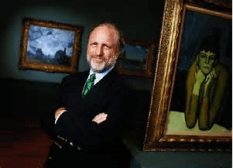
In James Cuno’s 1993-94 Director’s Report from the Harvard Art Museum the image communicated is of generously funded and well supported scholar curators devoting time and energy to researching exhibitions, publishing in journals and catalogues, supporting acquisitions, devising and presenting lectures and mentoring curatorial interns, who are themselves carrying out research to inform the museum’s exhibitions and publications. All told the sense is that, as an unashamedly academic art museum that is part of a university, research is recognised as vital in fulfilling the institution’s remit and is resourced accordingly.

In contrast, Robert Anderson’s 2005 article ‘To thrive or survive? The state and status of research in museums’ portrays a rather gloomier scenario. Focusing on UK museums, Anderson argues that a combination of competing pressures on curators, lack of time and financial support and negative perceptions of the scholar more broadly has led to a deprioritising of curatorial research. Instead curators are caught up in fundraising and administration, leaving them little time to research or write and present in conferences alongside their academic peers.

lone scholar
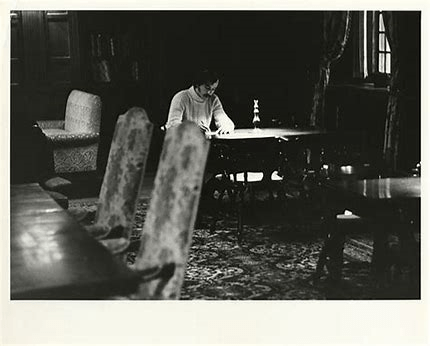
Is this an accurate image of today’s scholarly curator?

So, which of these portrayals is more accurate in today’s art museum? The answer, based on my interviews and experience is both and neither. The curators I spoke to did lament the lack of time they had for research and writing in particular, and acknowledged the absence of financial support and inconsistent institutional backing for research across the organisations they work in. Yet at the same time each one described to me research they had done and were doing to broaden the collection, catalogue acquisitions or realise an exhibition. They spoke in detail about the questions or issues that prompt their investigations and the methods they employ, not only to synthesize existing thinking, but to create original knowledge. They talked about how this knowledge is shared through exhibitions, catalogues, talks and wider education programmes and how it contributes to their own professional development and to the intellectual growth of others within and beyond the museum. I came away from each conversation enlightened and amazed by the richness and variety of curatorial research that is being done.


The interviewees’ thoughts on who curatorial research is for were especially interesting to me. Cuno and Anderson imply that curatorial scholarship is a largely solitary exercise conducted primarily for the academic community. However, these curators focused more on the importance of sharing their knowledge with the wider public. And they described how they acknowledged and at times incorporated the needs and expertise of others, including visitors, in their work. They mentioned collaborations with museum colleagues and projects involving co-curation with young people. Even though they voiced frustrations about their packed schedules, I did not get a sense they wanted to hide themselves away to do research for a small and select audience. Instead they wanted longer time and increased resources to be able to explore art and ideas more deeply for and even with a broad range of people, within and beyond the museum.

I have come away from these interviews with a sense of how curatorial research can and does work in the twenty-first century art museum. For me it is not a question of whether curatorial research should be supported – that is essential – but more that the model of the lone curator scholar detached from the art museum’s responsibility to operate inclusively and share and generate knowledge collaboratively needs to be questioned and rethought.


Making Space for Reflection on Participative Practice

How do we make space for participative practice and action research in our work in museums?  This was the first question posed at a one day seminar held at the University of Leeds on January 19th that I attended.  The event, which brought together about 30 museum professionals, researchers and students, was organised by Kayte McSweeney from the British Museum, Helen Mears from Brighton Museum & Art Gallery and Julia Ankenbrand, a collaborative doctoral partnership student based between Leeds University and the British Museum. The day in Leeds was the third of four events being organised as part of a wider research project that is funded by the British Museum – ‘Making Meaning in Museums – Making Space for Participative Practice’ – which is exploring how museum participation can be located within the context of participatory and action research. Given my interest in museum research, you can imagine how enthusiastic I was, not only to hear about this project, but also to take part in the discussions on the day.

The seminar began with introductions from Kayte, Helen and Julia and an acknowledgment that the fourth member of the research team, Helen Graham from Leeds University, was sadly unable to attend.  The speakers set out the ambitions for the day – for us to reflect on how we can understand the multiple ways of generating knowledge within the museum and share practical ways of using participatory and action research to enhance the work we do in collaboration with audiences. We were reminded of the quote from the psychologist Kurt Lewin that ‘research that produces nothing but books will not suffice’ and tasked with remaining positive.

And so to the first question – how do we create space for reflection and research?  Working in small groups we tackled the challenge of carving out intellectual, emotional and physical space to be able to question, examine and reflect on our work with and within museums.  My table included two museum professionals, two PhD students (both of whom had worked in or with museums), a colleague whose area of expertise was audience research and myself.  Our experiences and viewpoints were similar in many ways.  For instance we agreed that the ways in which programmes and activities are framed determines whether there is space for experimentation.  The fixed outcomes that can be built into community engagement projects constrain opportunities for organic development and divergence.  Similarly, excessive workloads inhibit the possibility of stepping back and reflecting.  However we focused on positives and recognised that embedding research and a culture of openness and trust into organisational strategies, structures and systems is not only possible but vital for a reflective and experimental space to exist.

20180119_123713

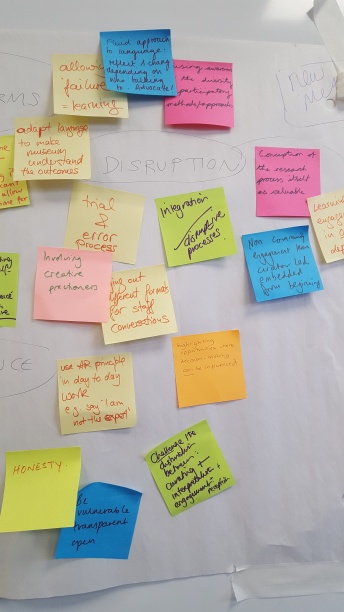
When the different smaller groups came together to share and categorize our post-it notes the ideas of how to create space for reflection and research coalesced around some key themes.  Some felt there was a need to challenge and disrupt organisational hierarchies and introduce new systems, both practical and conceptual.  These ranged from including research in everyone’s job titles to realigning internal perceptions of curatorial and pedagogic expertise.  Alongside this there was recognition that disruption needed to be accompanied by the embedding of a culture of learning and reflection across an organisation – it was not enough for change to be instigated, it also needed to be sustained. At the same time there was a sense that the museum needed to commit to sharing power and authority if communities were genuinely to be involved in action research processes. I was encouraged by these observations as they resonate with my own experiences in museums but also with the emergent findings from my research.

20180119_122037

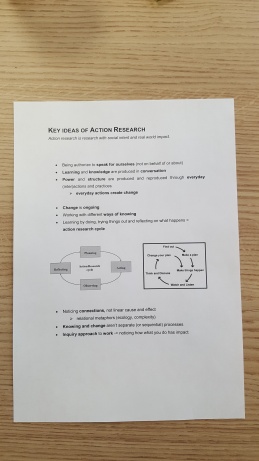
Action research as a methodology that can address issues of social justice and bring about change was the focus of the next session.  Julia provided us with a useful one page summary and gave us a whistle-stop tour through the key principles of action research, touching on the importance of recognising  how different forms of knowledge – from propositional or theoretical (or as I like to think of it ‘know what’) to practical (‘know how’) knowledge – are revealed through conversation.  She drew our attention to the importance seeing ongoing change happening through everyday actions and allowing participants’ narratives to guide any action research project.  Julia recommended the Sage Handbook of Action Research, a text that I would also point people to if they are interested in finding out more.

After lunch we were invited to join one of three tables to explore either ‘the different ways of knowing’, ‘community engagement as research’ or ‘action research for change’.  I opted for the first one, curious to find out about others’ perceptions of knowledge. I was rewarded with a wide-ranging conversation that touched on how we can establish parity between practitioner and propositional knowledge and the importance of recognising the multi-dimensional knowledge bases that co-exist within the museum.  I was introduced to the concept of a ‘folksonomy‘, by which the knowledge of those beyond the museum can act to enhance or challenge an official taxonomy of objects and heard about the Cardiff Story Museum where people’s stories as revealed through their objects chart the city’s history.  These optimistic tales of opening up the museum to diverse knowledges were inspiring. Nonetheless, the conversation reminded me that I need to be alert to the relationship between knowledge and power and mindful of how the museum can privilege certain narratives.

The feedback from the other two tables indicated that their discussions had been equally rich.  I was struck particularly by questions that emerged from one conversation that focused on the importance of differentiating between community engagement and research and between a ‘researcher’ and an ‘engager’.  Did research impose a different and perhaps more distant relationship between a project co-ordinator who designated herself as a ‘researcher’ and a community group? What were the ethical implications of involving individuals in a research project and was there a danger of exploitation?  What would be our motivations for framing engagement as research and who would benefit the most from this?  There was general consensus that locating ourselves as researchers brought particular responsibilities, not least in terms of the ways we documented any process of action research and how we shared ownership of the knowledge generated through a collaborative enquiry.

I have only put down the bare bones of what we covered during the seminar here, but I hope it gives a sense of the key issues that were discussed and the depth of thinking that people brought to the tasks.  I came away brim-full of ideas and very aware of the appetite amongst museum professionals and researchers for further debate and greater commitment towards research in museums.  Kayte, Helen, Helen and Julia are organising the final seminar in this series in Glasgow in late February/Early March.  I would urge you to look out for it and attend if you can.


Making collections ‘meaningful’

In the recently published Independent Review of Museums in England led by Neil Mendoza that was commissioned by the Department for Digital, Culture, Media and Sport, one of the recommendations made is that museums should promote deeper and richer engagement with their collections, ‘to make them accessible to the public, not just physically, but meaningfully as well’. I have been reflecting on this idea – of making collections ‘meaningful’ – whilst writing up my notes following a recent visit to Trapholt museum in Denmark.
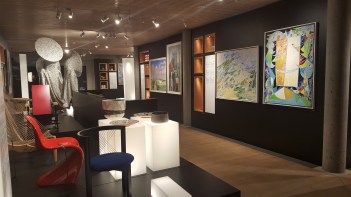
Trapholt is a museum of art and design in Kolding, Southern Denmark, about two and a half hours from Copenhagen by train. The museum is housed in a modern building and has a vibrant programme of temporary exhibitions, talks, workshops and outreach projects. It has a spacious, light-filled café and a museum shop. The museum’s vision is to be the most engaging, accessible and responsive art museum in Denmark and to make art and design a significant part of people’s lives. At the heart of this ambition is the museum’s collection of nineteenth, twentieth and twenty-first century art and craft objects and furniture that is on permanent display.

20171205_093319 (1)
I became interested in Trapholt some years ago when I met the Director Karen Grøn at a conference. In conversation with Karen it became clear that we shared an interest in the value of research within the museum and the challenge of translating theory into practice in our work. We kept in touch and came together (with Berit Anne Larsen, the Director of Learning and Interpretation at the National Gallery of Denmark) in 2015 to co-host a seminar with Danish and UK museum practitioners looking at building research and evidence-based programming in galleries. Together we produced a small publication titled ‘Developing Research in the Museum: Reflections from the UK and Denmark’ that included the papers that had been given in the seminar. Since then I have followed Karen’s work at Trapholt with interest, particularly the programmes and installations she has developed with colleagues that invite visitors to become curators. It is this work that seems especially relevant in terms of enabling museum visitors to make meaningful connections with a collection.
Since 2001 Trapholt has been experimenting with a method they refer to as ‘curating’ to enable all their visitors, including those with little or no art historical knowledge to make personal connections with art works. The most recent and sustained iteration of this is the Your Exhibition display which uses digital technology to enable visitors to curate their own shows. Your Exhibition is underpinned by ten years of research at Trapholt. This research evidenced that the act of curating an exhibition for themselves enriched visitors’ understanding of the artworks and created greater awareness of the institution. They found that curating brings visitors closer to the art, allowing them to invest the works with their own interpretations and meanings.

20171205_093139 (2)
When I visited Trapholt in December 2017 I spent over an hour in Your Exhibition. I chose my own theme and originally selected twelve artworks from the displays, which I was prompted subsequently to reduce to the six ‘that fit your theme the best’, to fill my digital gallery space. I decided on how the items were to be arranged in the space and selected a colour for the walls. I took a photograph of myself to go alongside the exhibition in a booth and gave the exhibition a title. Finally, I projected my exhibition onto a large wall in the display space and elected to have it emailed to me.

20171205_091010 (1)

It was a compelling experience, not least because it prompted me to spend time looking closely at the objects, imagining how they might work alongside each other and considering how they would illuminate my chosen theme. It involved me in making decisions, at times prompted by the questions that popped up during the digital curation process, which I frequently revised as I tried out my ideas. It challenged me to think hard and gave me a real sense of satisfaction once I had produced the final show. It also made me pay greater attention to the displays in the rest of the gallery after I had finished.

20171205_092429 (1)
Reflecting on Your Exhibition, two things have struck me particularly. The first is that the attention to detail in the display reveals the depth of thinking and research that has gone into its realisation, from the tone of the questions to the physical materials used. The intervention manifests Trapholt’s commitment to understanding their audiences and devising ways of supporting visitors to actively and joyfully engage, irrespective of their level of art historical knowledge. My second observation is that Your Exhibition invites the visitor to embark on a process of enquiry, to test out ideas, experiment and develop new knowledge. In effect, Your Exhibition invites the visitor to become a researcher of sorts.
Perhaps this is what is needed to make collections ‘meaningful’?

Action Research in action – the example of the Irish Museum of Modern Art

I have been travelling again, this time to the Irish Museum of Modern Art (IMMA) in Dublin. I have long been an admirer of the work that IMMA has done in collaboration with artists and their local community over the last 26 years, so I valued the opportunity to spend three days in Dublin, speaking with Helen O’Donoghue (Senior Curator: Engagement and Learning) and her colleagues, reviewing material that IMMA has kept on its projects and being in the museum itself.

20171122_094821 (1)

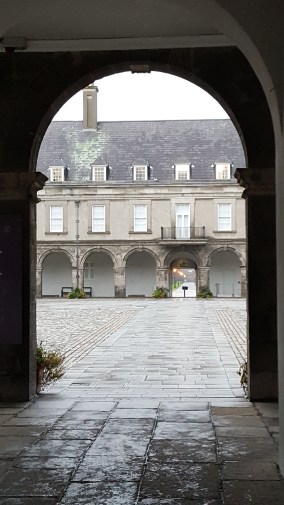
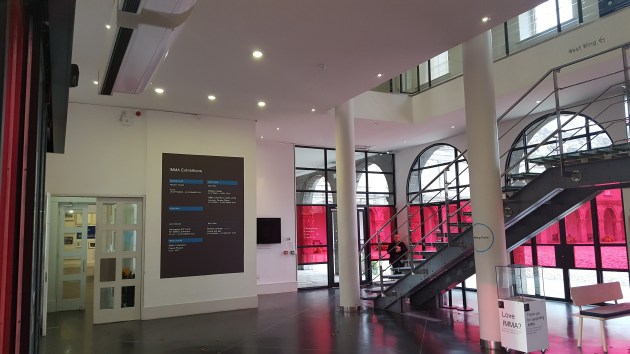
IMMA is housed in the seventeenth century Royal Hospital Kilmainham, a building that was for 250 years a home for retired soldiers. The Museum opened in 1991 and holds the Irish National Collection of Modern and Contemporary Art, which is comprised of work by Irish and International artists. IMMA has a vibrant exhibitions programme and an artist-in-residence scheme as well as its extensive Engagement and Learning programme. The latter was in existence prior to the Museum’s inauguration and has continued to expand and innovate to the present day.

A key reason I am interested in IMMA is because of how they have translated their mission – to connect audiences with art and provide an open and participatory space where people can experience something new and share knowledge and new thinking – into their programmes, and the essential role that research has played in this. Writing in 2009 Helen identified that what was then referred to as Education and Community programmes ‘interact with all aspects of the broad IMMA programme and are informed by action-research and participants’ feedback.’ In the same text, she also acknowledges that ‘current programmes have been informed by a series of research projects that were put in place from the outset of IMMA’s existence, to test out ideas and situations and develop good practice in the field of arts education and artists’ collaborative practice’. It is these early models of research-led practice, as well as IMMA’s current work, that I am keen to explore further, to understand how they functioned effectively within the museum and what they can tell us about collaborative, artist-led creative praxis in the context of a modern and contemporary art museum.
Speaking to the IMMA staff and reading the material that relates to the projects and programmes that ran at the Museum during the early to mid-1990s, what emerged for me is the value of having a clear strategy for access and education, alongside the realisation that the context and leadership of the museum played a significant part in enabling the experimental activities that were put in place at that time. The building itself, for example, opened up (or perhaps necessitated) an innovative approach, as the Royal Hospital is neither a conventional white cube gallery space, nor is it located in the centre of Dublin. Equally IMMA did not have a substantial acquisitions budget, hence was required to think differently about how it would work with artists and build the collection. The environment thus encouraged new and untried modes of programming and audience engagement.

20171121_110159

Of equal importance was the fact that the founding Director, Declan McGonagle, was committed to working with the local community to enable them to be active in shaping IMMA’s future, whilst Helen as the programmer for community and education, brought her expertise and values as an artist involved in socially engaged practice. Together they developed and implemented a strategy founded on collaborative learning that involved a series of experimental interventions working with artists and different local constituencies. These initiatives aimed to explore how a contemporary art museum could be relevant to people’s lives, whilst providing a space where local, national and international visitors were empowered to question art and the museum and interrogate how both functioned in the world. In this way, the strategy was, in part, activated by testing models of art practice in partnership with local communities.
There is not space here to detail these projects individually, but some of the extraordinary work that took place at that time includes the Unspoken Truths project, which involved the artist Ailbhe Murphy working with two Dublin women’s groups and the IMMA Education and Community department over five years from 1991 and which drew on the principles of community development and arts education. The project involved the women coming together to share and make visible their experiences and culminated in the Unspoken Truths exhibition that was shown at IMMA and toured to venues throughout Ireland, with the women involved devising workshops to accompany the exhibition and going on to speak about their work at national and international conferences.
What interests me particularly about Unspoken Truths, apart from the degree of commitment by all those involved, is the acknowledged inbuilt and ongoing evaluative process that informed the development of the programme. In simple terms, every stage of this emergent project was jointly examined by all those taking part, with this reflection and analysis determining the next stage of activity. This democratic process helped dismantle the hierarchies between the women, the artist and the museum, and enable a programme to develop that allowed for maximum participation and the authentic representation of each individual’s experience. The process of doing, reviewing and applying what had been learnt in practice required careful negotiation, but built trust and introduced a degree of critical rigour that insured that the process and outcomes were true to the ambitions everyone had for the project. New knowledge was generated by all those involved and the process brought about outcomes that made a positive difference to the museum and participants and had an impact in the wider world.
As such the project seems to exemplify what Levin and Greenwood (writing in Denzin and Lincoln’s 2013 text) see as the essential components of action research. For these writers, action research should be socially meaningful and responsible and grounded in the research participants’ lives. The process of action research involves a collaborative learning process – ‘where good arguments support transformative learning for all’ – that results in practical solutions that generate new knowledge and bring about social change. Levin and Greenwood argue that action research makes ‘direct connections between theory and practice,’ a process that is enhanced by bringing together diverse expertise in real world contexts.
With this in mind, I am interested in digging deeper into how IMMA’s work from the 1990s onwards can be located as research-led creative practice and what this adds to our understanding of artist-led participatory practice in the museum. Action research is a term that has been applied, at times loosely, to work undertaken by education departments in museums. However, reading the final report on Unspoken Truths which documents and evaluates the project’s progress and analyses the model of practice adopted, it is apparent that the project raises some interesting questions in relation to the approach to action research Levin and Greenwood advocate. I will be worrying away at these over the next few months.


What I am aware of already is that this framework of collaborative action research has shaped how IMMA engages with communities in all their projects subsequently, not least the ground-breaking work the museum undertook over nine years in the 1990s with artists and local women to address the issue of violence against women (Once is Too Much). This, and all the work that IMMA continues to do, relies in Helen’s words on ‘critical energy and open-mindedness’ on the part of the museum and those it works with. This is evident in the early projects and in IMMA’s more recent initiatives which continue to embody the values established when the museum opened, even though the context has changed. The work reveals how a framework of artist-led collaborative and creative knowledge generation within the context of the art museum is effective when all those taking part are prepared to explore and challenge their ways of working and subject their thinking and actions to rigorous interrogation that may bring about significant change.

Research within Communities of Practice

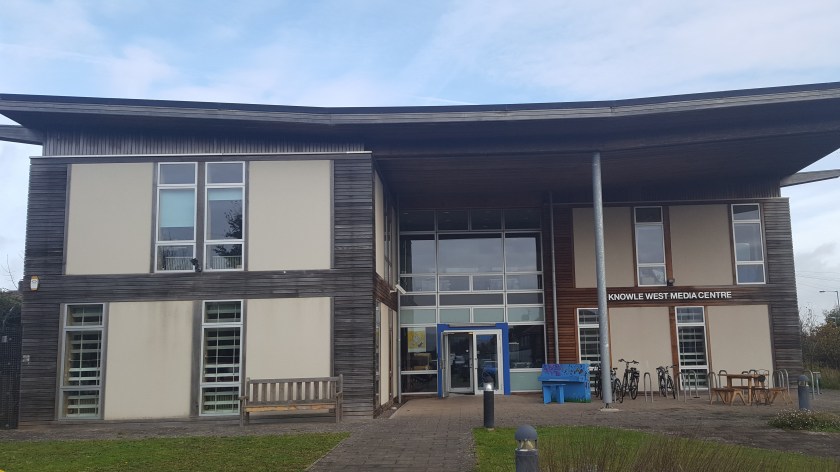
In early November, I spent a day at the Knowle West Media Centre (KWMC) in Knowle West, an estate in the south of Bristol, at the invitation of Dr Roz Stewart-Hall who is Head of Research and Evaluation there. KWMC describes itself as an arts centre and charity that supports individuals and communities to get the most out of digital technologies and the arts through providing relevant ways for people to get involved in community activism, education, employment, and local decision-making. The Centre was established in 1996 and now operates out of two sites in Knowle West – their headquarters, built using innovative straw bale construction techniques in 2007 and the Factory which is a workshop space offering design and making facilities. KWMC facilitates group activities, workshops, events and exhibitions in both sites. They host residencies and provide work experience and engage in long-term research-led programmes designed with local residents to address issues and provide solutions, for instance to the current housing crisis.

20171109_104757 (2)
In the hours I spent at KWMC I had the chance to see the buildings, interview staff, walk through Knowle West and see their work in action. I spent time in the office and the Factory and was taken to see the prototype house that has been built as part of the ‘We can make… homes’ project, which is led by KWMC in collaboration with designers and researchers from the University of the West of England. It was a very rich and thought-provoking day that I have been reflecting on since the visit. Here are some of my provisional thoughts.
In my conversations with staff and observations of the working practices at the Centre I was struck by the extent to which KWMC functions as a community of practice (CoP). The concept of the CoP was first introduced by Jean Lave and Etienne Wenger in 1991 to explain how specific relationships between people, activities and the world determine how learning and knowledge generation take place through forms of situated practice. Within CoPs the focus on ‘community’ is essential, providing opportunities for individuals to develop sustained relationships and do things together, with a shared purpose. However, not all forms of work done jointly with others can be understood as a community of practice, since the latter requires that there is highly effective sharing of information, awareness of everyone’s roles and contributions, clearly defined identities and a store of knowledge built up over time that everyone can access and contribute to. When these are in place individuals within the community of practice can learn, communicate their knowledge and develop their practice.
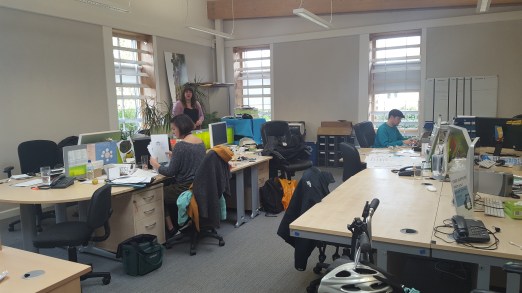
What I witnessed at KWMC, which has been supported by further reading, suggests that these characteristics are to be found in the vision, working context, forms of organisation and types of social interaction at the Centre. For example, knowledge sharing is afforded through the open-plan layout of the offices, as well as through formal organisational structures, including twice-weekly ‘huddles’ where everyone in the organisation comes together to discuss current activity. Jess, the KWMC Learning Manager recognised that these meetings are ‘a chance to know what everyone else is doing’ and provide ‘the ability to respond to things as they are happening,’ in other words, they enable ideas and information to be shared and problems resolved.


20171109_121015
The KWMC offices


Newcomers are introduced to the KWMC ethos and working practices through formal induction, but also through more informal processes of working alongside more experienced co-workers. Ongoing reflection and evaluation is built into their work in a process akin to action research to enable tacit learning to be made explicit, to be fed back into practice and disseminated to the wider community. Perhaps most significantly, throughout the organisation there is a tangible commitment to ongoing change and a sense shared by those that work there that how the organisation works is fundamental to why they exist – their commitment to shared learning and innovation are manifest in their systems and structures as well as their work with others.


20171109_112554
An example of a project evaluation

What also emerges very clearly is that the work that KWMC do is informed comprehensively and directly by a set of values that foreground the experience and expertise of the community members who take part in their projects. This has been formalised as ‘The Bristol Approach’ which, as the KWMC website describes, is ‘a way of working that aims to understand the issues people care about. Rather than ‘pushing’ technology or pre-determined ‘solutions’ onto people, The Bristol Approach focuses on supporting people to work together to ‘pull-in’ the knowledge, technology and resources needed to tackle a problem.’ The approach is realised in practice through projects that are framed, as Roz said, as ‘a research process starting with the issues that people from the local community think are important and need to be addressed.’ These research projects involve those from the community who have expertise in relation to the issue being investigated and who will be directly affected by the findings and outcomes of the process, staff from KWMC, artists and other professionals including academics who are interested in the topic and bring their expertise to tackle a particular problem.
In reading more about CoPs I was directed by my colleague Pip Laurenson to an article by Ash Amin and Joanne Roberts that digs deeper in the concept and comes up with a typology of CoPs, differentiating between four groups that they perceive have distinct properties. One of these groups they understand to be characterised by ‘epistemic/creative knowing’. These groups, unlike other CoPs, bring together ‘experts’ on a temporary basis to generate creativity and explore issues, motivated by a strong commitment to a unifying problem.
On reading this I became interested in thinking how The Bristol Approach can be allied to this model of epistemic CoPs. With each project KWMC ‘pulls-in’ individuals from the community and beyond to tackle issues raised by the community. Crucially, everyone involved in the project, from the young person, for example, to the academic is located as an ‘expert’ and KWMC go to considerable lengths in designing projects to try and ensure that a non-hierarchical structure exists where everyone’s contribution is valued equally. The Centre staff I interviewed recognise that this is not always possible and that academic partners can sometimes struggle with this formulation, in part as it invites them to research with rather than on others and to recognise forms of knowledge different from their own. However, in seeking to establish an open space where various individuals are invited in to explore ‘uncharted territory’ together, according to Amin and Roberts, KWMC is creating the conditions for new ideas that are relevant and applicable in a community context to thrive.
I have been inspired by this visit and prompted to consider how the characteristics of effective CoPs, and specifically epistemic/creative communities of practice can be fostered in the art museum. Focusing on systems and structures that promote non-hierarchical knowledge sharing and support innovatory thinking are uppermost in my mind.


Research, ‘impact’ and an interesting ethical issue

-My research is being funded through an Arts and Humanities Research Council (AHRC) Early Career Leadership Fellowship. These opportunities, as the AHRC website outlines, are provided to enable researchers to ‘carry out individual research which has the potential to generate a transformative impact on their discipline’. The ambition for this scheme is that researchers and research findings make a contribution within their specific fields, but also ‘act as advocates for the value and benefits of arts and humanities research to publics beyond academia’.   Although I am not employed by a university, I was eligible to apply for this funding as Tate (where I work) is designated as an Independent Research Organisation, which means that the gallery is recognised by the AHRC as having the capacity to carry out research in-house, independent of a university.

The differences between my status as a practitioner researcher working in a cultural organisation and a university academic undertaking research were on my mind on Monday as I attended a conference organised by the AHRC for current Fellows. The day provided an opportunity for us all to meet each other, share details of our research and hear presentations from researchers on topics that included working with the media and how best to support research assistants. It was fascinating to get a glimpse of the range of topics the AHRC funds – from human-forest relations to Jazz on BBCTV – and in equal measures daunting and reassuring to compare with other researchers (all of whom are university-based) what we were doing, how we were going about it and what we hoped to get out of it.
In the afternoon, I listened to a engrossing presentation given by Dr Henrik Schoenefeldt, Senior Lecturer in Sustainable Architecture at the University of Kent who is temporarily based at the Houses of Parliament. He is embedded in the team who are restoring the historic Palace of Westminster researching the original Victorian ventilation system. Whilst providing riveting insights into the architecture of the building, the focus of Dr Schoenefeldt’s talk was on generating ‘impact’ from research. Impact is understood by the AHRC to be the way in which research influences and makes a difference to individuals and communities and adds value in the world. In the case of Dr Schoenefeldt’s research, impact has taken the form of journal articles, a book, articles in professional journals and seminars that are informing the fields of academia, architecture and conservation. Perhaps most significantly, his research is directly feeding into Parliamentary decision making on the restoration process itself. He mapped out in a slide what his leadership role is in different fields and how the various fields interact.

20171106_151503

Dr Schoenefeldt also talked about the relationship between academic and professional contexts and how research can feed into ‘real life’ projects.  He outlined a nine stage thinking process to determine how we could identify the relationship between research and its wider application in our projects.

20171106_152711

In a conversation with him and other Fellows following this talk some different views emerged of what constituted academic research and research undertaken in practice or vocational contexts. Dr Schoenefeldt recognised, as an architect, that practitioners are engaged in research all the time and saw his work as connecting to and intertwining with that research. Similarly Dr Sorcha O’Brien from the University of Kingston, whose research is looking at the influence of rural electrification on the lives of rural Irish housewives in the 1950s and 60s is working collaboratively with curators at the National Museum of Ireland – Country Life in in Castlebar, County Mayo on an exhibition.  She too was clear that she was combining her’s and the museum professionals’ research. In both of these cases it was not so much a question of ‘impact’ in the sense that research undertaken by an academic is done and dusted and then applied in a practice setting.  Their research appeared more as a joint sharing of knowledge over time toward a common goal.

Yet for other academics in this conversation, all of whom were keen to have their research make a difference in the world, working alongside practitioners or policy makers during the research process did not appear to be so straightforward.  For instance, one colleague talked about the challenge of even starting conversations with policy makers and that making the time that is needed to develop relationships and build trust is not always possible.

This last observation is not meant as a criticism of those researchers, but I mention it because the exchange prompted me to think that, as a practitioner researcher based in a cultural organisation, crossing the boundary between the academic and practice context is relatively easy. My work environment and close professional relationships align towards practice and uppermost in my mind is for this research to shape museum policy and activity. Also, not working in a university means currently I am not accountable to the Research Excellence Framework (REF) which is the system for assessing the quality of research in UK higher education institutions and which determines the allocation of university research funding.  The REF is based on an accountability system determined in part by the quantity and quality of scholarly publications and other research and although impact is also assessed, academic colleagues I have spoken to have acknowledged that they feel they need to prioritise academic research outputs that can be counted towards the REF, as this has a significant bearing on their career progression. My professional development, in contrast, is predicated primarily on how my research and activity directly improves practice as well as how it is received in academic circles.  Our motivations, therefore, are slightly different.

However, the embedded position of the practitioner-researcher brings issues with it that university-based colleagues might not have to negotiate. In a conversation on the day of the seminar with an academic colleague, I mentioned that my place of work – Tate – was one of the case studies for my research. Her response, said with a smile, was ‘will you still have a job at the end of it?’ This question, albeit light-hearted, raised the key issue of how I maintain a sufficient critical distance and detached position to be able to report on my findings openly and honestly. It reinforced the need for me to consider at all times the ethical implications of a research project that involves close colleagues and to be mindful constantly of my own position as a researcher attempting to make sense of and interpret mine and others’ experiences, situations and phenomena from within the practice itself.

I am giving considerable thought to these issues and am finding reassurance in the fact that I am locating my case studies within a wider theoretical context.  I am also researching with and not on my fellow practitioners, with whom I can discuss these concerns as the research progresses, as well as testing my findings with my academic mentor and other critical friends who are generously helping and advising me on the way.  Later on in the project I will interrogate provisional findings with a wider group of university and museum-based colleagues to test ideas and gather feedback.  By being as conscientious, open and transparent as I can, sharing, testing and reviewing, I hope to draw on the best of both worlds – the immersed condition of the practitioner, balanced by the scholarly rigour of the academic researcher.

Reflections on ‘Learning About Culture’

On Tuesday I attended the launch of the Learning About Culture Programme at the RSA.  This new initiative is described in its prospectus as a ‘two-and-a-half year investigation into the role that cultural learning plays in improving educational outcomes for children.’  The Programme has two aims – to build a stronger evidence base for cultural learning and to improve the use of evidence in cultural learning.  At the launch event which was extremely well attended, from my observation, by representatives from cultural organisations, funders, academic institutions and government departments, we heard from the project partners (the RSA and the Education Endowment Fund (EEF)), from London Bubble who run Speech Bubbles, one of the cultural learning projects taking part and from Project Oracle who are involved in the evaluation.  We also had the opportunity to discuss and respond to the Programme via round table discussions.

Since Tuesday I have been wondering why, even though there is a great deal about this Programme that is constructive and will make a valuable contribution to the sector, it makes me uneasy.  In part to understand my own response, I have put some thoughts down here.


Tate Schools picture
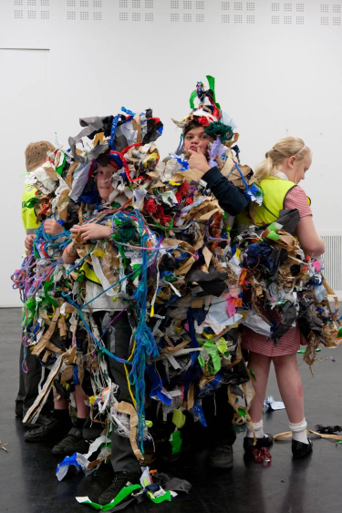
Schools Programme Tate Modern, Copyright Tate Photography

As I say there are many positives with Learning About Culture.  The Programme acknowledges that there is a decline in the hours spent learning arts subjects in schools and makes a valid and persuasive argument for more evaluation of arts interventions.  Much is rightly made of the importance of cultural organisations having a theory of change in place about how their activities might lead to change, and a strong case is put forward for these organisations recognising that evaluation and reflective practice can and should focus on improving practice rather than justifying what has taken place for an external funder. They are mindful of the need for more training for cultural practitioners in using evaluation and will be conducting research on the use of evidence in cultural learning. As such the Programme is allied to existing studies including the recent AHRC Cultural Value Project that argue for further research to account for the human experience of art and culture, as well as restating thorny issues that have been around for some time.  Francois Matarasso, for example, outlined a clear case for robust evaluation of arts programmes in the 1990s, using language and arguments that in some respects are similar to that found in the Learning About Culture document.

However where Matarasso and the Learning About Culture programme differ is in the key issue of value, for as he says in the 1996 Defining Values: Evaluating Arts Programmes report; ‘The important, and essentially political, question about evaluation is which value system is used to provide benchmarks against which work will be measured – in other words, who defines value.’  It is in relation to the value system underpinning the Learning About Culture programme that my uneasiness, as a someone working and researching in the arts, surfaces.  The Programme makes it very clear that, in order to make the case for the arts in schools, what is needed is ‘evidence of the additional progress that cultural learning enables children to make.’  This progress is to be assessed primarily in terms of academic achievement and secondarily in terms of ‘non-cognitive skills – a set of attitudes, behaviours, and strategies thought to underpin success in school and at work, such as motivation, perseverance and self-control’.  The main methodology adopted to provide evidence of the impact of cultural interventions in schools is large scale randomised control trials, although there will also be ‘deep-dive’ and follow-up research in schools using a range of methods.

The Programme argues that the focus on providing evidence of the impact on attainment is necessary because first this will help persuade schools of the value of the arts, and second because too often cultural organisations assert that their work makes a positive contribution to attainment without sufficiently ‘robust evidence for the impact on attainment in literacy and numeracy and limited rigorous research into impact on ‘non-cognitive’ skill development or attainment within specialist subject study.’ This is definitely where my uneasiness starts to build into full-scale worry.  There is not space here to restate the arguments made elsewhere on the importance of valuing arts activities on their own terms (although I find the observation in the Cultural Value Project report that we are interested in studying whether music improves ability in maths, but not whether studying maths improves ability in music sums up the issue around subject hierarchies pretty neatly).

Instead I want to reflect on what constitutes robust evidence, comparing the Learning About Culture Programme’s understanding with mine as a practitioner researcher and what this tells us about values.  The Programme has developed a typology of evidence-gathering methods, with each level providing progressively more reliable evidence for impact.  Level 1 includes anecdotal quotes and personal observations rising up through three further levels to end with Level 5 which includes comparison groups or control trials, which are ‘the highest standard’.  In Learning About Culture, therefore, rigour and robustness are intrinsically linked to notions of objectivity and the scientific method.  Underlying this is the belief that it is possible to control the conditions and variables of an art intervention sufficiently to be able to confidently assert causation – i.e. that nothing apart from the intervention under scrutiny is responsible for the measurable change. The knowledge that has value here is that of the independent and objective evaluator who having conducted the tests to determine if progress has been made, defines success.

For those working in collaborative, qualitative and arts and practice-based research scenarios, different value-systems prevail.  Rigour is linked more closely to ideas of research authenticity, applicability and replicability – do the methods and findings ring true to those who have direct experience of the intervention and are they helpful in demonstrating how work might improve in contexts other than the specific one in which the research took place. ‘Objectivity’ is questioned and instead ‘expert knowledge’ and ‘everyday perceptions,’ as Keri Facer and Kate Pahl state, inform the findings and build the evidence base.  Within the arts specifically there is recognition that the practice is complex, not always linear and at times contradictory. Concepts such as joy or irreverence, frustration and being oneself are not measureable, yet can potentially be communicated through a narrative, enacted through a performance or made explicit in a film. These research outputs constitute powerful evidence of change that can be used by practitioners to support reflection on their practice and improve their work.


Tate Exchange Event, Tate Modern
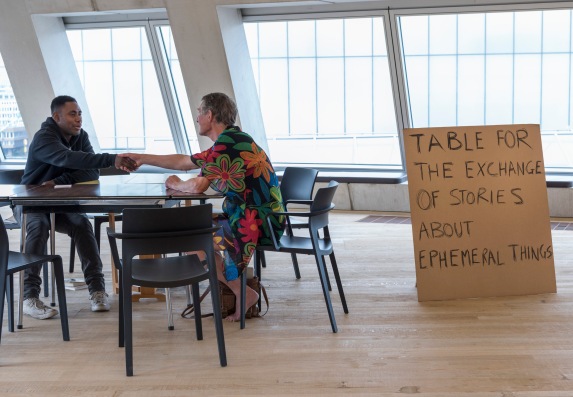
Tate Exchange Event, Tate Modern, Copyright Tate Photography

So I am keen to see how the Cultural Learning Programme develops. I welcome their acknowledgement that ‘cultural learning practitioners may also have distinctive strengths when it comes to monitoring, evaluation and learning’ and support their ambition to work with the sector ‘using a broad range of evaluation approaches’. With this in mind I hope that the Programme recognises that RCTs are but one method for assessing and evidencing the changes that cultural programmes can bring about.  In my mind the Programme will achieve something truly extraordinary if it can communicate not only the value of cultural learning, but also the importance of evidencing it in rich and complex ways that resonate for practitioners, educators and policy makers.